
Locating Your Home Assessed Value and Official Property Records
Where to Find Your Home’s Assessed Value
Start with your county property appraiser’s website. Search by street address or parcel number, open your property’s official record, and look for the assessed value for the tax year you need. In Central Florida, check the year and any separately listed taxable value: exemptions can make the taxable value lower than the assessed value.
The assessed value helps determine property taxes. It is not the same as the price your home could sell for today, so use the official record for tax questions rather than an online home-value estimate.
I’m Scott Brazdo, MBA, a Central Florida REALTOR® who specializes in luxury homes and helps buyers and sellers put property records in context. When clients search “find assessed value of my home,” I point them to the county record first, then help them understand what that number does and does not say about market value.
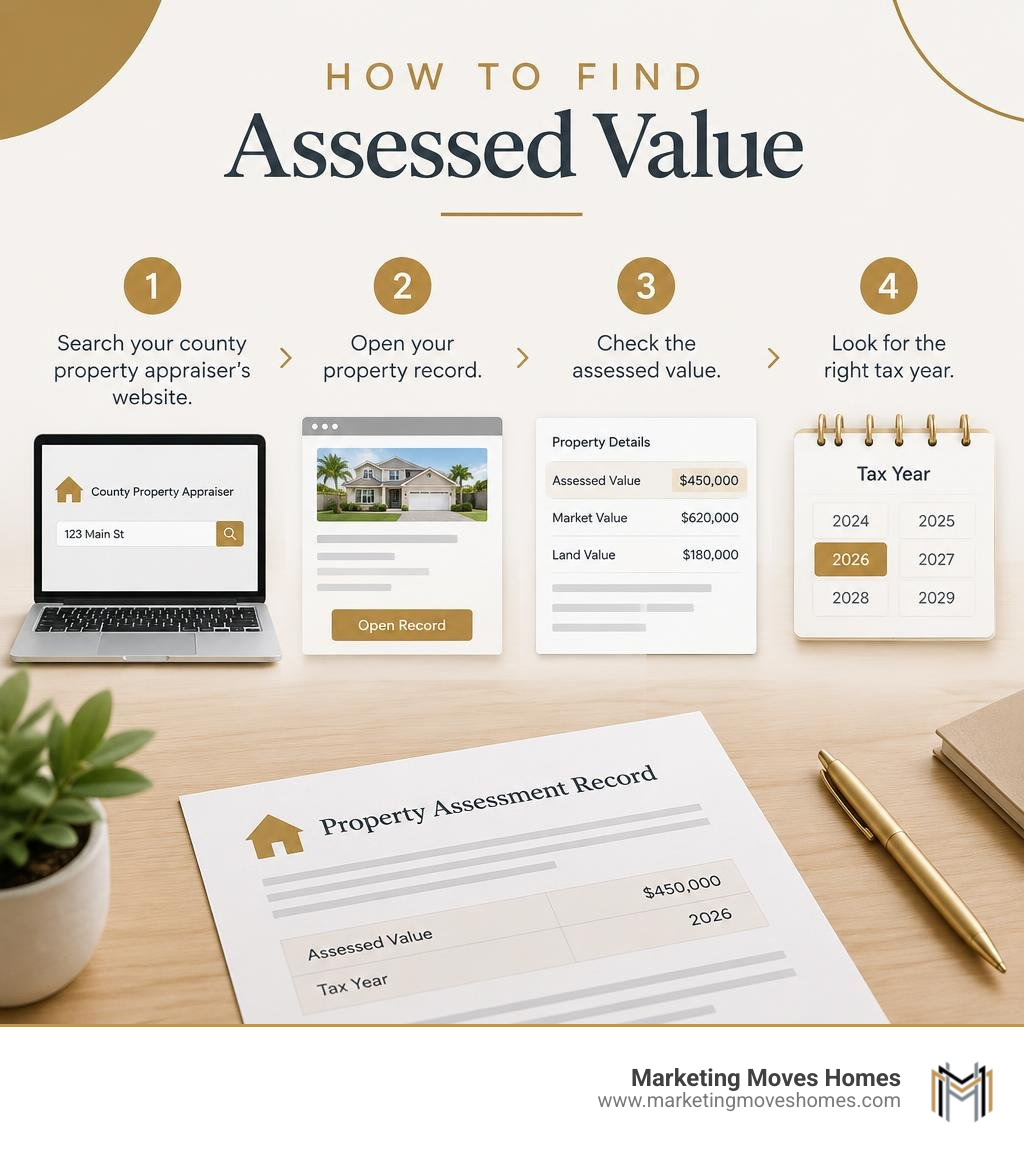
Find assessed value of my home terms simplified:
Assessed Value vs. Market Value and Appraised Value
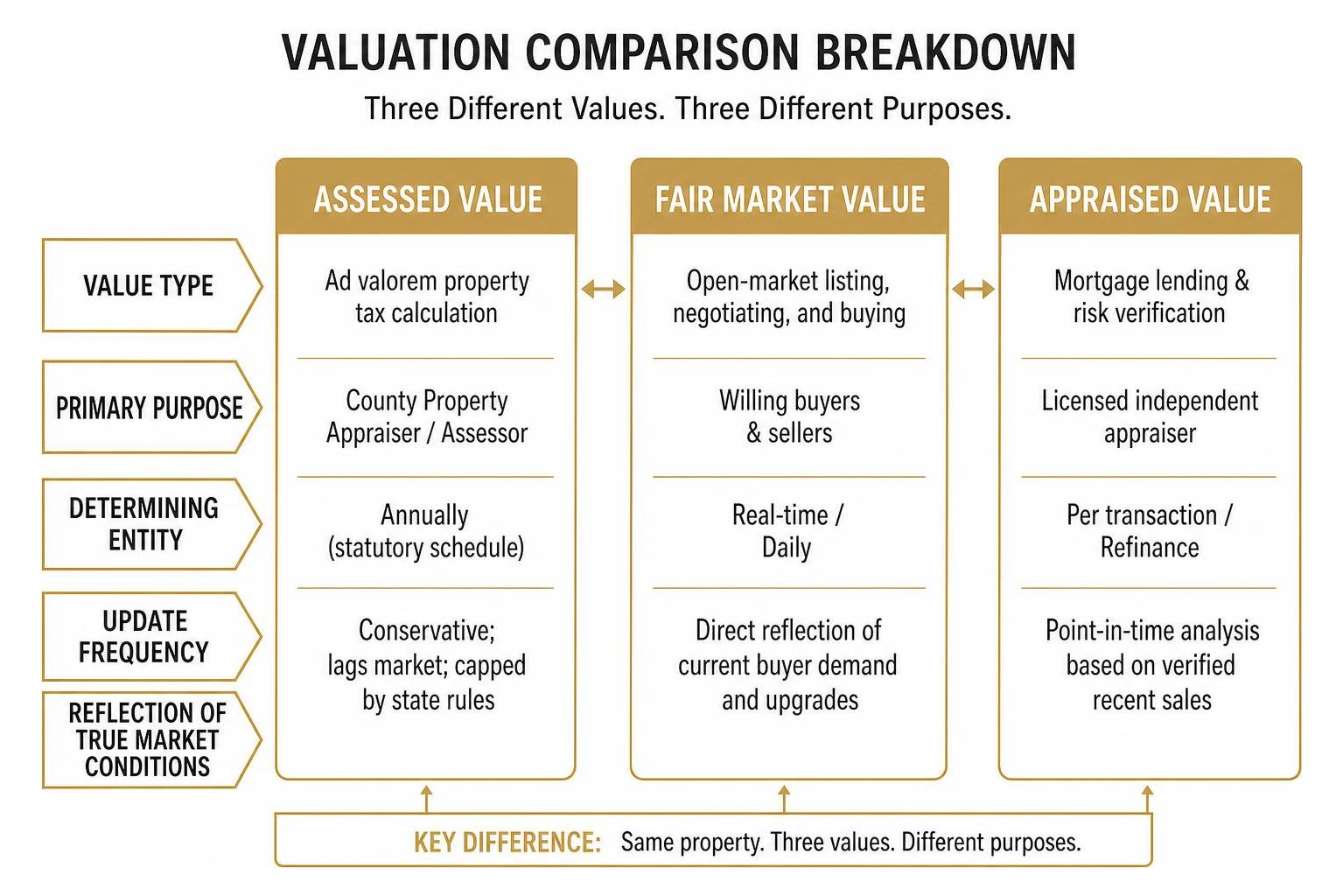
Understanding property valuation requires separating three distinct metrics: assessed value, fair market value, and appraised value. Homeowners often encounter these numbers simultaneously, but each serves a completely different financial purpose.
- Assessed Value: This is the dollar value assigned to your property by the local county government (such as the Orange County Property Appraiser) solely for calculating ad valorem property taxes. It is governed by state statutes, reassessment schedules, and statutory caps like Florida’s Save Our Homes amendment. Assessed value is not what a buyer will pay for your house today.
- Fair Market Value: This represents the actual price a willing, qualified buyer would pay a willing seller on the open market under normal, unforced conditions. Market value moves continuously in response to supply, buyer demand, neighborhood prestige, interest rates, and architectural upgrades. Nationwide, the median existing home sale price stood at $429,100 in August 2026 (up 1.6% year-over-year), but in high-demand luxury enclaves like Lake Nona, Windermere, and Winter Park, market values command significant premiums.
- Appraised Value: This is an independent, comprehensive valuation prepared by a state-licensed professional real estate appraiser. According to the Appraisal Institute, over 90% of residential real estate transactions require a professional appraisal to satisfy lender underwriting criteria and confirm collateral value before mortgage approval.
To see how these concepts interact in everyday scenarios, homeowners can explore the ins and outs of home value estimates to avoid confusing tax records with current equity.
| Valuation Type | Primary Purpose | Determining Entity | Update Frequency | Reflection of True Market Conditions |
|---|---|---|---|---|
| Assessed Value | Ad valorem property tax calculation | County Property Appraiser / Assessor | Annually (statutory schedule) | Conservative; lags market; capped by state rules |
| Fair Market Value | Open-market listing, negotiating, and buying | Willing buyers & sellers | Real-time / Daily | Direct reflection of current buyer demand and upgrades |
| Appraised Value | Mortgage lending & risk verification | Licensed independent appraiser | Per transaction / Refinance | Point-in-time analysis based on verified recent sales |
How Property Appraisers Determine Tax Assessments
County appraisers do not walk through every single home in Central Florida each year. Instead, they use mass appraisal systems. Mass appraisal applies computerized valuation models across entire neighborhoods, analyzing historical sales, building permits, heated square footage, lot size, construction class, and geographic subdivisions.
Assessors establish a base market value for the tax roll as of January 1 each year using the sales comparison approach (analyzing prior year transactions) and cost approach (estimating land value plus structure replacement costs minus depreciation). However, automated algorithms miss custom interior finishes, designer outdoor kitchens, private putting greens, and luxury interior conditions.
Impact on Monthly Housing Payments and Property Taxes
Your annual property tax bill directly depends on your local millage rate and taxable value. One mill equals $1 of tax for every $1,000 of taxable property value. In simple terms:
Tax Bill = (Taxable Assessed Value ÷ 1,000) × Total Local Millage Rate
Effective property tax rates vary across the country, averaging approximately 0.9% nationally. When county appraisers increase your assessed value, or when millage rates adjust during municipal budget meetings, your annual property tax bill increases. For homeowners with an escrow account attached to their mortgage, the lender recalculates monthly payments to ensure sufficient funds exist for the annual tax distribution. A higher assessment leads directly to an escrow shortage, raising your monthly housing expense. To understand how equity and property metrics align, reviewing a step-by-step guide to estimate home value accurately provides clear clarity on real property worth.
Step-by-Step Instructions to Find Assessed Value of My Home
Locating your official assessment records takes only a few minutes when you navigate official public databases rather than relying on unverified third-party algorithms.
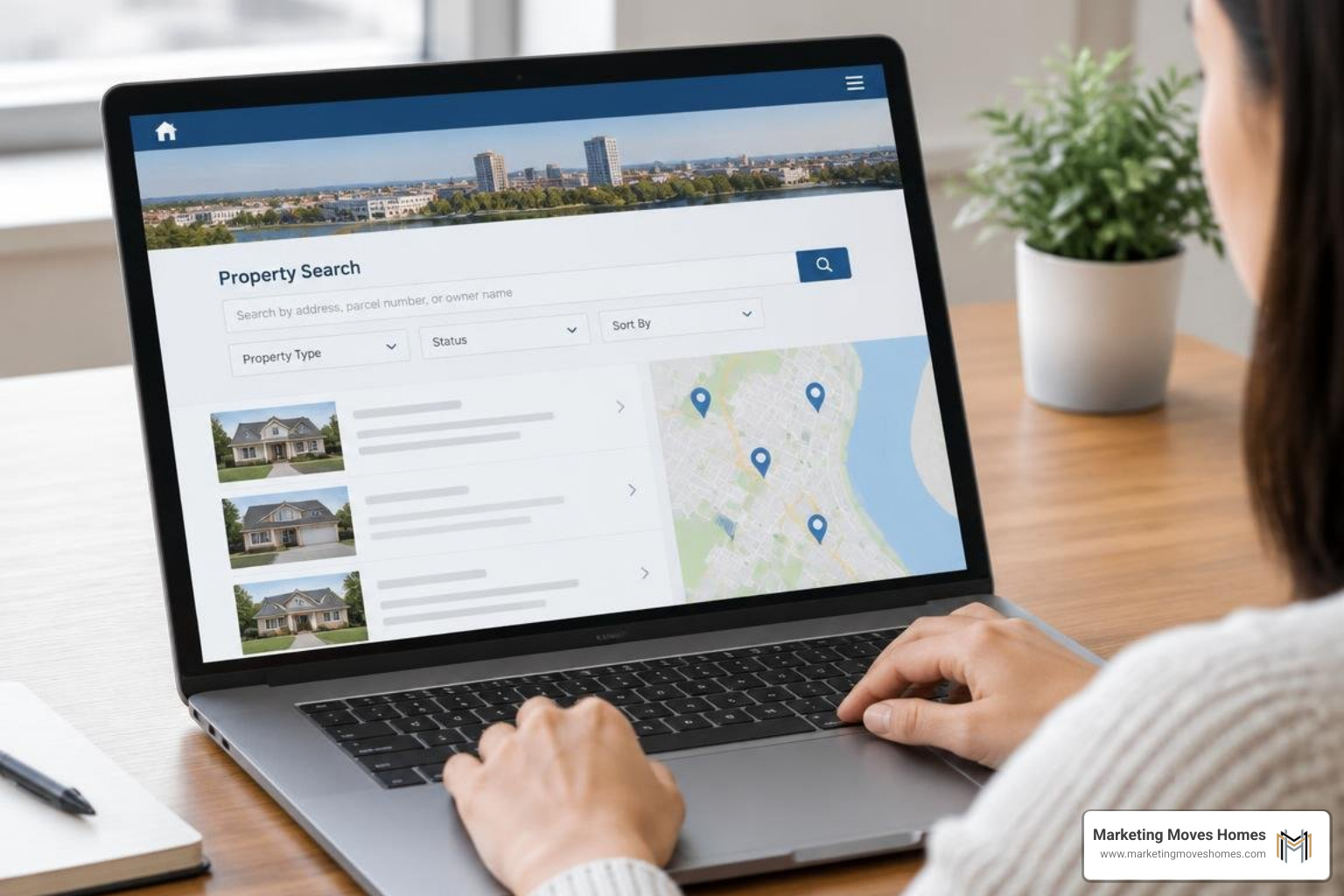
- Locate Your Property Identifier: Grab a recent tax bill, closing document, or simply note your exact street address. Locating your 12-to-18-digit Parcel Identification Number (Parcel ID or APN) will produce instantaneous search results.
- Access the County Property Appraiser Portal: Navigate to the official website of the county where the property is located.
- Execute the Property Search: Select the public records or parcel search tool. Input the street number and name (omitting extensions like “Street” or “Court” often prevents formatting search errors), or paste the Parcel ID.
- Locate the Current Tax Year Summary: Open the parcel detail page. Navigate to the “Valuation” or “Tax Roll” tab.
- Review the Assessment Breakdown: Verify the Just/Market Value, Assessed Value (capped under statutory protections), Exemption Deductions, and Net Taxable Value.
- Review the Annual TRIM Notice: Every August, Florida property appraisers mail the Truth in Millage (TRIM) notice. You can view digital archives of this notice directly within your online parcel file.
For homeowners new to navigating municipal systems, our beginner’s guide to getting a home value estimate provides foundational context on interpreting public property data.
Accessing County Portals to Find Assessed Value of My Home
In Central Florida, public property assessment portals offer deep transparency into historical valuations, legal land descriptions, and structural data:
- Orange County: The Orange County Property Appraiser provides detailed GIS mapping tools, permit tracking, historical TRIM documents, and exemptions management for properties throughout Lake Nona (including 32827 and 32832), Downtown Orlando, College Park, Dr. Phillips, and Winter Park.
- Windermere & Isleworth Enclaves: High-value parcels across Southwest Orange County feature custom land breakdowns, accessory structure values (such as boathouses and guest casitas), and specific taxing district line items.
- Surrounding Municipalities: Nearby portals provide streamlined parcel lookup tools containing deed recordings, subdivision plat maps, and historical building cards.
When viewing your record, check every recorded detail: heated square footage, bathroom count, garage stalls, and exterior amenities. Mass appraisal errors in basic physical dimensions are frequent causes of inflated tax assessments.
Key Reasons to Find Assessed Value of My Home in Florida
Checking your official assessed value regularly serves essential financial objectives:
- Verifying Tax Accuracy: The National Taxpayers Union Foundation notes that approximately 30% to 60% of homes across the country are over-assessed in any given year. Spotting errors before formal deadlines ensures you do not overpay local municipal taxes.
- Evaluating True Equity and Long-Term Value: Knowing the gap between your capped taxable value and real-time luxury market value helps when projecting your estimated home value in 10 years for wealth management and legacy planning.
- Estate and Transaction Strategy: Whether structuring family trusts or planning a strategic market listing, having verified baseline tax records prevents surprises during buyer escrow evaluations.
Reassessment Cycles, Home Renovations, and Special Assessments
Assessment schedules dictate how quickly changes in real estate prices translate into your tax records. Florida operates on an annual reassessment cycle. Every property’s value is set based on market data as of January 1 of each tax year.
While healthy, sustainable real estate markets typically experience annual appreciation rates of 3% to 4%, reassessment values adjust according to state statutory boundaries.
How Luxury Renovations and Remodels Affect Assessed Value
When you pull building permits for significant architectural enhancements—such as a custom pool pavilion, second-story primary wing expansion, or high-end kitchen transformation—the local building department notifies the county property appraiser.
Assessors review the declared permit valuation and adjust the property’s physical characteristics for the subsequent January 1 assessment roll. However, ordinary maintenance and minor interior modernizations that do not expand square footage or require structural permits rarely trigger drastic assessment spikes. For instance, while industry data indicates a minor kitchen remodel recoups approximately 112.9% of its cost in open-market resale value, assessors evaluate structural additions rather than designer paint colors.
Understanding Special Assessment Taxes and Infrastructure Fees
A standard property tax bill contains both ad valorem taxes (based on assessed value) and non-ad valorem assessments.
Special assessments are flat fees levied to fund specific capital improvements or community services benefiting a defined geographical area. Unlike general property taxes:
- Special assessments are not based on your home’s assessed dollar value.
- They fund designated projects like stormwater management, neighborhood road resurfacing, fire protection districts, or municipal solid waste collection.
- In master-planned Central Florida communities—particularly throughout Lake Nona, Dr. Phillips, and Windermere—infrastructure is often funded via Community Development District (CDD) assessments or Municipal Service Taxing Units (MSTUs). These capital improvement bonds are amortized over 20 to 30 years and billed directly on the annual property tax statement.
Property Tax Exemptions and Appealing an Over-Assessed Home
Maximizing statutory exemptions and maintaining fair tax records directly protects your bottom line. When calculating net proceeds during a sale or evaluating annual holding costs, understanding how exemptions reduce taxable obligations is paramount. You can see how carrying costs interact with transaction outcomes when you calculate net proceeds in 3 simple steps.
Qualifying for Homestead and Specialty Tax Exemptions
Florida offers strong tax protections for primary residences through the Homestead Exemption:
- Baseline Exemption: Reduces your property’s taxable value by up to $50,000 for primary residents who own and occupy the home on January 1 and submit their application by March 1.
- Save Our Homes (SOH) Assessment Cap: This constitutional amendment limits annual increases in the assessed value of a homesteaded property to 3% or the Consumer Price Index (CPI) rate, whichever is lower. Over several years of strong market appreciation in areas like Lake Nona and Winter Park, SOH creates substantial savings by keeping your assessed value well below current market worth.
- Portability: Homeowners moving within Florida can transfer (“port”) up to $500,000 of accumulated Save Our Homes tax savings to a new primary residence.
- Specialty Exemptions: Additional statutory deductions exist for qualifying seniors, disabled veterans, surviving spouses of first responders, and individuals with permanent disabilities.
Informal Reviews vs. Formal Assessment Appeals
If you review your August TRIM notice and discover that your home’s assessed value exceeds its actual fair market value, you have the legal right to challenge the assessment.
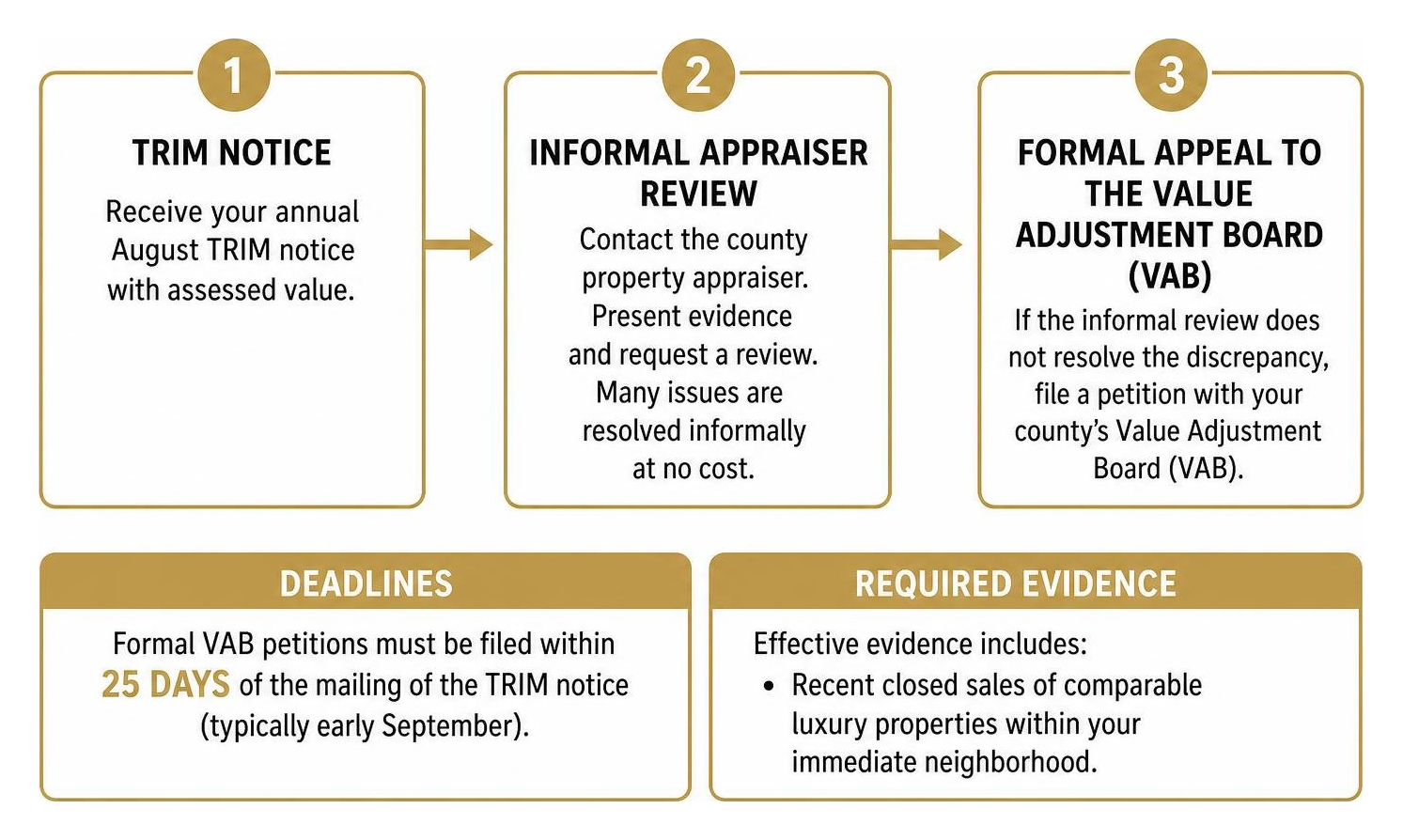
- Step 1: Informal Appraiser Review: Contact the county property appraiser’s office immediately upon receiving your TRIM notice. You can present documented evidence—such as a recent appraisal, structural defects, or verified neighborhood comparable sales—directly to a deputy appraiser. Many mass-appraisal errors are resolved informally at this stage at zero cost.
- Step 2: Formal Appeal to the Value Adjustment Board (VAB): If the informal conference does not resolve the discrepancy, you can file a formal petition with your county’s Value Adjustment Board.
- Deadlines: In Florida, formal VAB petitions must be filed within 25 days of the mailing of the TRIM notice (typically early September).
- Required Evidence: The National Taxpayers Union reports that fewer than 5% of homeowners challenge their assessments, yet the majority who properly prepare clear evidence win at least a partial reduction. Effective evidence includes:
- Recent closed sales of comparable luxury properties within your immediate neighborhood.
- Professional licensed appraisals conducted near the January 1 tax valuation date.
- Contractor estimates or engineer reports detailing required structural, roof, or foundation repairs.
- Photos proving uncorrected physical obsolescence or errors in the county’s recorded heated square footage.
Frequently Asked Questions About Assessed Property Values
How often is my home reassessed in Central Florida?
In Central Florida and throughout the state of Florida, properties are reassessed annually. The statutory valuation date is January 1 of each calendar year. The county property appraiser evaluates regional sales data from the preceding 12 months to determine the Just (Market) Value, applies applicable caps to calculate the Assessed Value, and mails the TRIM notice to homeowners in mid-to-late August.
Can an assessed value be higher than the actual market value?
While assessed values typically lag market values due to conservative mass appraisal algorithms and statutory caps, an assessed value can exceed actual market value during sudden market shifts, localized economic transitions, or if the property suffers unrecorded physical damage. If your assessed value is higher than what your luxury property would realistically command on the open market, you have grounds for an immediate TRIM appeal.
How does a change in assessed value affect my closing proceeds?
At closing, property taxes are prorated between the buyer and seller based on the number of days each party owned the property during the calendar year. If the final tax bill has not yet been issued, the closing agent uses the previous year’s assessment or the current year’s TRIM estimate. Accurate tax calculations are vital when estimating real estate closing costs easily to verify your exact net funds at the closing table.
Conclusion
Understanding your property’s assessed value gives you control over your property tax obligations and provides context for long-term financial planning. While public county records establish your tax baseline, they do not reflect what discerning buyers are willing to pay for your luxury property in today’s active Central Florida market.
At Marketing Moves Homes, we specialize in luxury real estate listings across Lake Nona (including 32827 and 32832), Windermere, Dr. Phillips, and Winter Park. Automated online algorithms and mass appraisal models miss the custom architectural finishes, premium lot orientations, and lifestyle narratives that define exceptional homes.
We utilize advanced listing strategies—combining high-end architectural photography, cinematic video tours, targeted digital campaigns, and curated direct outreach—to showcase luxury properties to qualified buyers and achieve top market value. Whether you are reviewing your property records or planning your next move, partner with our team to buy a home or position your current residence for a successful, high-yield sale. Contact Marketing Moves Homes today for a private, comprehensive market valuation and strategic pricing consultation.