Charming Past: A Guide to Orlando Historic Districts
Charming Past: A Guide to Orlando Historic Districts
Orlando’s Hidden History: What You Need to Know About Its Historic Districts
Orlando historic districts are a surprisingly rich part of a city most people associate with theme parks and tourism. From 1880s Victorian storefronts to Craftsman bungalows and Mediterranean Revival homes, Orlando has carefully preserved neighborhoods that tell the real story of how this city grew.
Quick answer — here are Orlando’s six local historic preservation districts:
- Downtown — Designated 1980; ~80 buildings from the 1880s to early 1940s
- Lake Cherokee — Designated 1981; 189 buildings, 160 contributing
- Lake Copeland — Designated 1984; ~110 residences
- Lake Eola Heights — Designated 1989; ~570 buildings across 38 blocks
- Lake Lawsona — Designated 1994; ~500 buildings
- Colonialtown South — Designated 2000
Beyond these six local districts, Downtown Orlando also has 15 individual buildings and seven districts listed on the National Register of Historic Places.
These districts cover everything from compact downtown blocks to sprawling lakeside neighborhoods. Whether you’re a buyer drawn to the charm of an older home, a seller in a protected neighborhood, or simply curious about Central Florida’s past, understanding these districts matters — for lifestyle, property value, and what you can (and can’t) do with a home.
I’m Scott Brazdo MBA, a Central Florida REALTOR® and Co-Founder of Marketing Moves Homes, with over 15 years of digital marketing experience and deep knowledge of the Orlando historic districts market, helping buyers and sellers navigate the unique opportunities these neighborhoods offer. In this guide, we’ll walk through everything you need to know — from the historical events that shaped these neighborhoods to the financial incentives available today.
Historical Catalysts: How the Great Freeze and the 1920s Land Boom Shaped Orlando
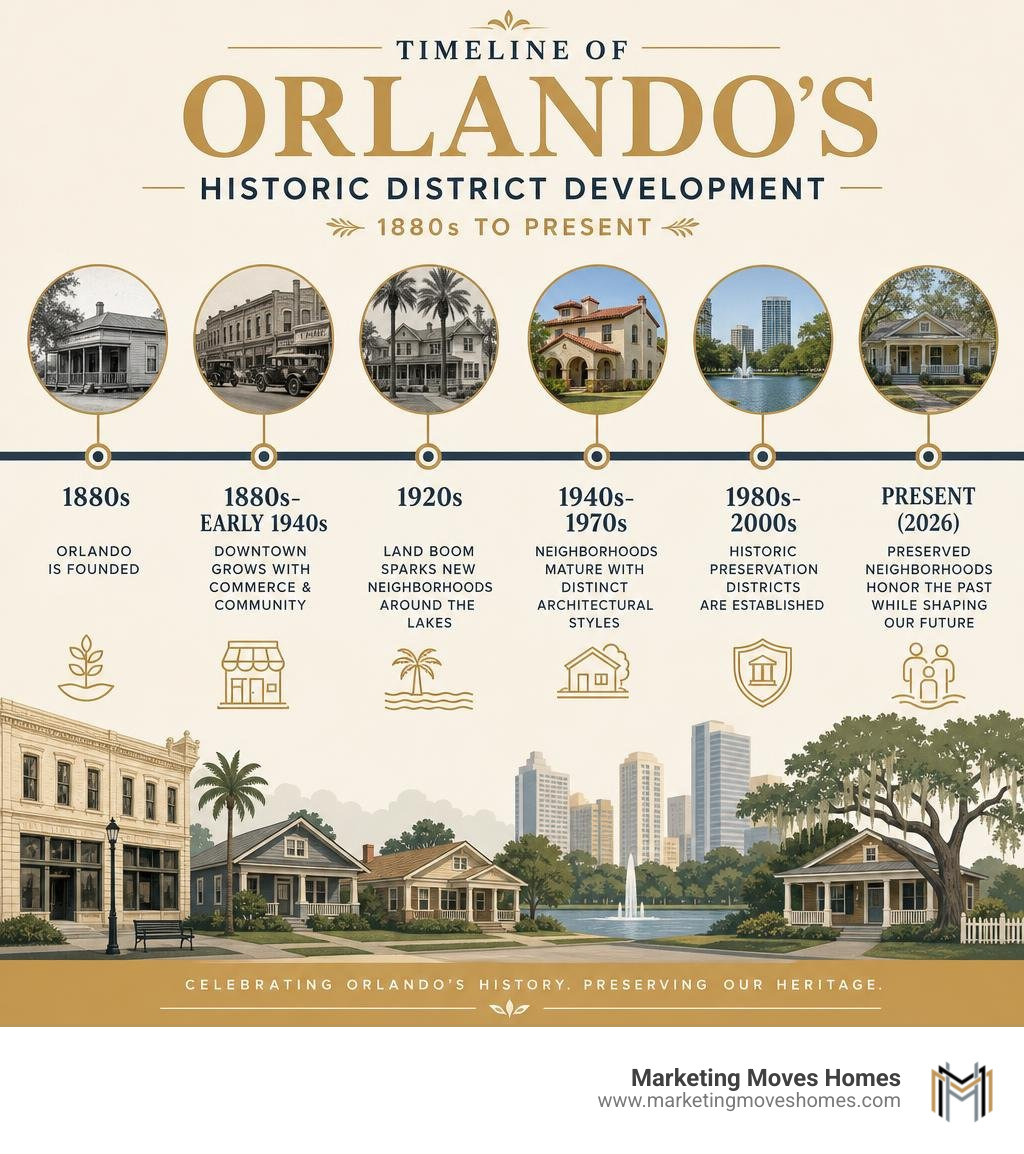
To understand why Orlando’s historic neighborhoods look the way they do in 2026, we have to look back at two defining moments in Florida history: the Great Freeze of 1894-95 and the 1920s Florida land boom.

Before the late 19th century, much of the land surrounding downtown Orlando was agricultural, dominated by sprawling citrus groves. Prominent figures like citrus grower Jacob Summerlin owned massive tracts of land—including a 200-acre parcel that would eventually become Lake Eola Heights.
Then came the winter of 1894-95. A devastating series of deep freezes swept through Florida, completely wiping out the citrus crops and killing the trees. For local growers, the “Great Freeze” was a financial catastrophe. Realizing that citrus farming was no longer viable so far north, landowners began looking for alternative ways to recoup their losses. The solution? Subdividing their agricultural lands into residential plots. This sudden shift from groves to home sites laid the geographic foundation for many of the historic neighborhoods we love today.
A few decades later, the 1920s land boom turned Orlando from a quiet agricultural town into a bustling urban center. As people flooded into Florida seeking sunshine and opportunity, developers rapidly platted new subdivisions. It was during this golden era of construction that neighborhoods like Lake Cherokee, Lake Copeland, and Lake Lawsona truly took shape. Grand Neoclassical Revival estates and cozy Craftsman bungalows rose along brick-paved streets, establishing a distinct architectural character that has survived for over a century. If you want to dive deeper into how these historical shifts impact modern real estate trends, check out our Blog for regular updates.
Preserving the City Beautiful: The Six Local Orlando Historic Districts
Orlando’s commitment to preserving its architectural roots led to the creation of six local Historic Preservation overlay districts. These local districts are designed to protect the unique character of our neighborhoods, stabilizing property values and ensuring that new construction is compatible with the old.
Let’s take a closer look at the unique history and makeup of these six local districts:
1. Downtown Historic District
Designated in 1980 as Orlando’s first local historic district, this area encompasses eight square blocks and approximately 80 buildings. Constructed from the 1880s until the early 1940s, these commercial structures represent the transition of Orlando from a frontier town to a regional financial hub.
2. Lake Cherokee Historic District
Established in 1981, this peaceful residential district south of downtown contains 189 buildings, of which 160 are classified as contributing structures. Formerly known as Lake Minnie, the area features grand homes from the late 19th and early 20th centuries, including the famous “Honeymoon Row” along the lake’s western shoreline.
3. Lake Copeland Historic District
Designated in 1984, the Lake Copeland district is home to approximately 110 historic residences. This neighborhood showcases a beautiful mix of early 20th-century architectural styles, nestled under a dense canopy of ancient live oaks.
4. Lake Eola Heights Historic District
Established locally in 1989 and added to the National Register of Historic Places in 1992, this district contains 487 historic buildings across 38 blocks. It is one of Orlando’s most architecturally diverse residential areas, featuring everything from late Victorian farmhouses to Art Deco multi-family units.
5. Lake Lawsona Historic District
Designated in 1994, this district contains approximately 500 historic buildings dating from 1911 through the 1950s. The neighborhood includes the scenic Washington Street Bridge, Fern Creek, and the lush Dickson Azalea Park.
6. Colonialtown South Historic District
Established in 2000, Colonialtown South represents the final years of traditional development patterns in Orlando before post-WWII suburban sprawl took over. It is highly celebrated for its dense collection of charming, modest Craftsman bungalows and Minimal Traditional homes.
For a detailed look at the official boundaries and local guidelines for these areas, you can explore the Historic Preservation Districts – City of Orlando resources.
How Local Orlando Historic Districts Differ from National Register Districts
One of the most common points of confusion for buyers and sellers in the Orlando market is the difference between a local historic district and a National Register district.
- National Register of Historic Places Districts: Administered by the state and federal government, this designation is largely honorary. It is designed to foster public pride, awareness, and education. Listing on the National Register places no restrictions on what private property owners can do with their homes. You can paint, remodel, or even demolish a National Register property without federal oversight (unless federal funding or tax credits are involved).
- Local Historic Preservation Districts: These are overlay zones established by the City of Orlando. Local districts carry strict legal protections. Any exterior modifications visible from a public right-of-way must be reviewed and approved to ensure the neighborhood’s historic integrity remains intact.
Navigating the Rules of Orlando Historic Districts: The Certificate of Appropriateness
If you own a home within one of Orlando’s six local historic districts, you must obtain a Certificate of Appropriateness (COA) before making any exterior alterations, additions, or demolitions. The review process is managed by the City of Orlando’s Historic Preservation Board:
- Minor Reviews: Small projects—such as changing paint colors, installing signs, or making matching repairs—can be expedited through the Minor Review Committee. This process is incredibly efficient, usually taking between 2 and 10 days.
- Major Reviews: Significant changes—such as building an addition, constructing a new detached garage, or altering a roofline—require a public hearing before the full Historic Preservation Board. This process requires careful planning, typically taking about seven weeks from application submission to approval.
Local design guidelines also include specific neighborhood rules. For example, in many districts, chain-link fences are strictly prohibited in front yards or areas visible from the street. Similarly, if you choose to screen in a historic front porch, the screening must be installed in a way that does not obscure or damage the original architectural columns or balustrades.
Standout Landmarks and Stories of Downtown Orlando
Downtown Orlando is home to 15 buildings and seven districts on the National Register of Historic Places, each holding its own piece of Central Florida lore:
- The Elijah Hand Building (1905): Located at 15-17 West Pine Street, this is one of the city’s most intact examples of late Victorian commercial architecture. Elijah Hand was a prominent local undertaker and furniture maker.
- Honeymoon Row: Along the west shoreline of Lake Cherokee sit five beautiful 1880s homes. They were built by newlyweds who moved to Orlando during the citrus boom, earning this scenic stretch its romantic nickname.
- The S.J. Sligh House (1925): Built during the height of the land boom for a staggering $25,000, this grand estate in the Lake Cherokee district is a textbook example of Neoclassical Revival architecture.
- The Wells’Built Hotel (1926): Built by Dr. William Monroe Wells, one of Orlando’s first Black physicians (who delivered over 5,500 babies during his career), this hotel provided safe lodging for African Americans during segregation. It hosted legendary figures like Thurgood Marshall, Jackie Robinson, and Ella Fitzgerald. Today, it stands proudly as a museum of African American history.
- Tinker Field: Built in 1922, this historic baseball field hosted countless Hall of Famers during spring training. It was also the site of Dr. Martin Luther King Jr.’s only Central Florida speech on March 6, 1964, which he delivered from the pitcher’s mound.
Architectural Heritage: Styles That Define Orlando’s Historic Neighborhoods
Part of what makes walking through Orlando historic districts so magical is the sheer variety of architectural styles. From the rustic simplicity of early Florida farmhouses to the grand symmetry of Mediterranean estates, these homes reflect the changing tastes of a growing nation.

| Architectural Style | Era of Popularity | Key Defining Features | Common Orlando Districts |
|---|---|---|---|
| Craftman Bungalow | 1910s – 1930s | Low-pitched gabled roofs, wide overhanging eaves, exposed rafters, large front porches supported by tapered square columns. | Lake Eola Heights, Lake Lawsona, Colonialtown South |
| Mediterranean Revival | 1920s Land Boom | Stucco walls, red clay tile roofs, arched windows and doorways, wrought-iron detailing, and decorative ceramic tile. | Lake Cherokee, Lake Ivanhoe, Winter Park |
| Colonial Revival | 1890s – 1950s | Symmetrical facades, multi-pane double-hung windows, decorative entryways with pediments and columns. | Lake Eola Heights, Lake Ivanhoe, Lake Copeland |
| Queen Anne / Victorian | 1880s – 1900s | Steeply pitched asymmetrical roofs, ornamental spindlework, wraparound porches, and textured shingles. | Downtown, Lake Cherokee, Lake Eola Heights |
| Art Deco / Moderne | 1930s – 1940s | Smooth stucco finishes, rounded corners, glass block windows, and geometric decorative motifs. | Downtown, Lake Ivanhoe, Lake Eola Heights |
| Minimal Traditional | 1940s – 1950s | Simple, compact layouts, low-pitched roofs with close eaves, minimal decorative detailing. | Colonialtown South, Lake Lawsona |
Many of these local masterpieces were designed by legendary architects. For example, James Gamble Rogers II designed several iconic residences in Central Florida, including the stunning Claybaugh House (1927) in Lake Cherokee, which features a mock bell tower and a beautifully pitched tile roof.
Beyond Downtown: Historic Character in Surrounding Central Florida Neighborhoods
While downtown Orlando holds a dense concentration of history, you don’t have to look far to find incredible historic character in the surrounding Central Florida communities. From the brick-lined streets of Winter Park to the citrus heritage of Winter Garden, these neighborhoods offer a unique slice of “Old Florida.”
College Park and Thornton Park
Located just minutes from the downtown core, these two highly desirable neighborhoods offer distinct historic vibes:
- College Park: Known for its vibrant main street along Edgewater Drive, College Park (Orlando) – Wikipedia ) highlights that this neighborhood features streets named after famous universities (like Princeton, Harvard, and Yale). It is filled with charming 1920s bungalows and mid-century homes. A local landmark is the College Park Publix, which has maintained its iconic 1950s neon-lit facade since the day it opened. College Park was also briefly home to legendary beat generation writer Jack Kerouac; his former cottage now serves as a residency for rising writers.
- Thornton Park: Situated directly east of Lake Eola Park, Thornton Park is famous for its brick-paved streets, massive canopy oaks, and historic homes featuring expansive wraparound front porches. It’s a neighborhood where historic charm meets a trendy, walkable urban lifestyle.
Winter Garden, Sanford, and Kissimmee
If you are willing to explore a bit further out in the greater Orlando area, you’ll find incredible historic downtowns that have become major cultural destinations:
- Winter Garden: Located on the southern shores of Lake Apopka, Winter Garden was once the center of a massive citrus empire. Today, its historic downtown—centered around Plant Street—is listed on the National Register of Historic Places. Visitors can stroll along the brick streets, explore the local Railroad Museum, or bike the famous 22-mile West Orange Trail. To learn more about living in this incredible community, explore our guide to Winter Garden. You can also check out the official Downtown Winter Garden – Home site for local events and shopping directories.
- Sanford: Situated on the shores of Lake Monroe, Sanford is one of Central Florida’s oldest incorporated cities, tracing its origins back to an 1830s military post. Its historic downtown features beautifully preserved 19th-century commercial brick buildings, a bustling marina, and a scenic RiverWalk.
- Kissimmee: Known for its rich cattle ranching and cowboy history, historic downtown Kissimmee features landmarks like the Osceola County Courthouse (listed on the National Register in 1977). The Kissimmee Historic District spans 70 acres and includes 189 contributing historic structures, including Makinson Hardware, which has operated continuously on Broadway since 1884.
Financial Incentives and Tax Credits for Historic Property Rehabilitation
Preserving a historic home is a labor of love, but it doesn’t have to be a financial burden. Both the federal government and the City of Orlando offer powerful financial incentives to encourage property owners to restore and maintain historic structures:
- Federal Investment Tax Credit (20%): If you own a certified historic, income-producing property (such as a commercial building or a residential rental property) in a designated district, you may qualify for a federal income tax credit equal to 20% of your qualified rehabilitation expenditures.
- 10-Year Local Property Tax Exemption: For homeowners in Orlando’s local historic districts, the City offers a highly lucrative property tax incentive. If you undertake a qualifying historic rehabilitation project, you can apply for a 10-year exemption that covers 100% of the City’s portion of property taxes attributed to the increase in your home’s value resulting from the rehabilitation.
These programs are designed to make historic preservation financially viable, ensuring these beautiful homes remain a staple of our community for generations to come. If you are looking to purchase a historic property and take advantage of these incentives, we can help you find the perfect home—just visit our Buy a Home page to get started.
Frequently Asked Questions about Orlando Historic Districts
How many historic districts are in Orlando?
Orlando is home to six local Historic Preservation overlay districts designated by the city, as well as seven historic districts listed on the National Register of Historic Places. The local districts are Downtown, Lake Cherokee, Lake Copeland, Lake Eola Heights, Lake Lawsona, and Colonialtown South.
Does living in an Orlando historic district restrict what I can do to my home?
Only on the exterior. If your home is in one of the six local overlay districts, any exterior changes visible from a public street, park, or lake must be approved by the Historic Preservation Board through a Certificate of Appropriateness (COA). However, you have complete freedom to remodel, update, or paint the interior of your home however you see fit.
Are there tax benefits for buying and restoring a historic home in Orlando?
Yes! The City of Orlando offers a 10-year property tax exemption on 100% of the value added to a property through an approved historic rehabilitation project. Additionally, owners of income-producing historic properties can take advantage of a 20% Federal Investment Tax Credit for substantial rehabilitations.
Conclusion: Partner with the Central Florida Historic Home Experts
There is an undeniable magic to living in one of the Orlando historic districts. The brick-paved streets, mature oak canopies, and unique architectural details offer a lifestyle that modern master-planned subdivisions simply cannot replicate. However, buying or selling a historic home requires specialized knowledge—from understanding local COA guidelines to accurately evaluating the condition of a century-old structure.
At Marketing Moves Homes, we are proud to be the premier real estate brokerage serving Orlando and the surrounding Central Florida communities. Whether you are looking to buy a historic bungalow in College Park, sell a grand estate in Lake Cherokee, or simply want to know what your historic home is worth in the 2026 market, we are here to help.
We don’t rely on generic online home estimators, which often miss the value of historic charm, custom upgrades, and neighborhood-specific nuances. Instead, we provide custom, hyper-local market valuations and back them up with a cutting-edge digital marketing strategy—including professional photography, video tours, and targeted outreach—to ensure our listings sell faster and for top dollar.
Ready to start your historic home journey? Contact Marketing Moves Homes today or email us at info@marketingmoveshomes.com to speak with a local expert!