Predicting the Near Future: A Guide to Estimating Your Home Value in 5 Years
Predicting the Near Future: A Guide to Estimating Your Home Value in 5 Years
Why Smart Homeowners Want to Estimate House Value in 5 Years Before Making a Move
If you want to estimate house value in 5 years, here is the short answer:
Use this formula:
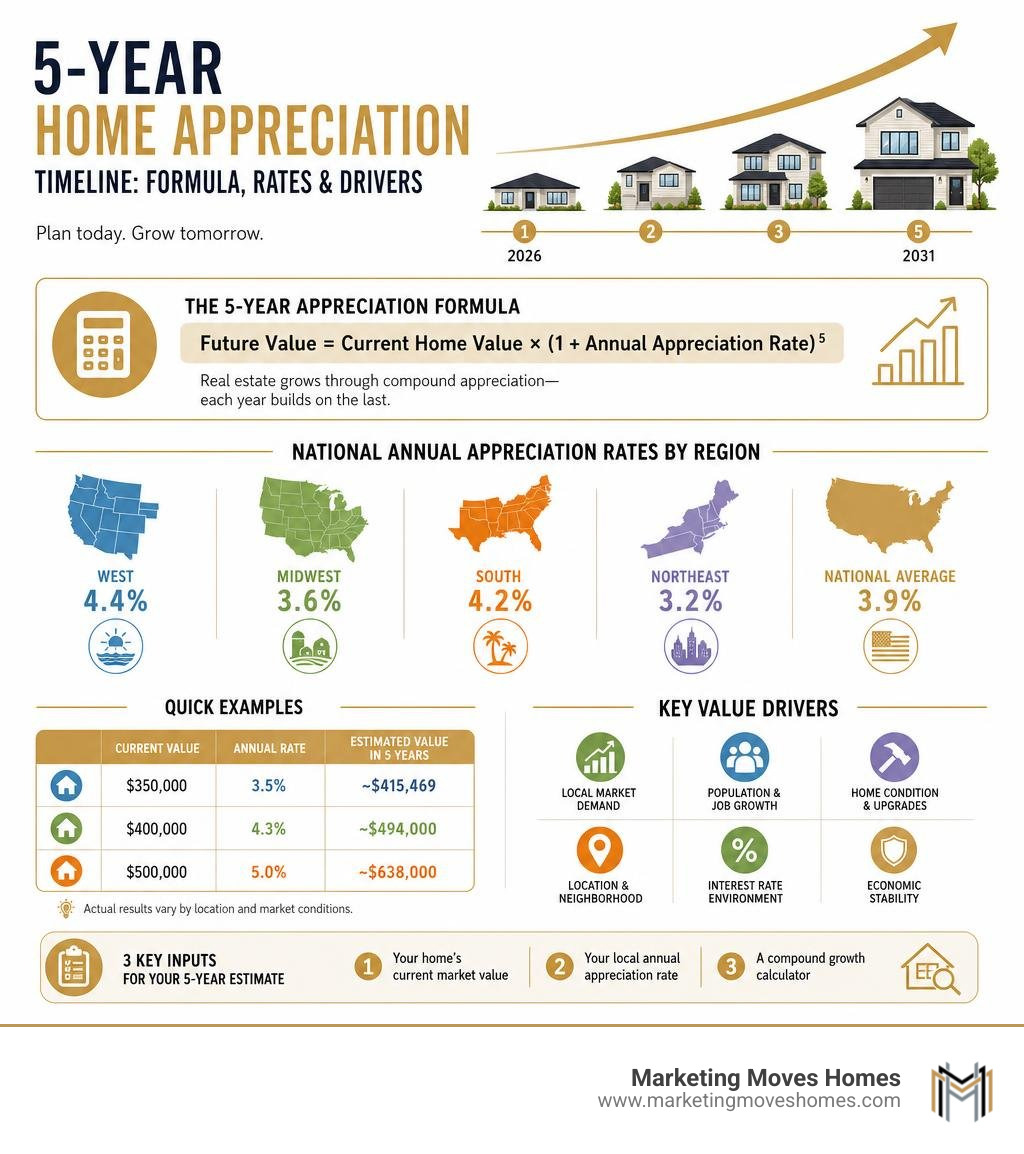
Future Value = Current Home Value × (1 + Annual Appreciation Rate)^5
Quick example:
| Current Value | Annual Rate | Estimated Value in 5 Years |
|---|---|---|
| $350,000 | 3.5% | ~$415,469 |
| $400,000 | 4.3% | ~$494,000 |
| $500,000 | 5.0% | ~$638,000 |
Key inputs you need:
- Your home’s current market value
- Your local annual appreciation rate (not the national average)
- A compound growth calculator
Knowing where your home’s value is headed is one of the most useful things you can do as a homeowner — or as someone thinking about buying.
Maybe you are deciding whether to sell now or hold for a few years. Maybe you want to know if a home you are about to buy will build equity over time. Or maybe you are planning a renovation and want to know if it will actually pay off.
Whatever the reason, the desire to estimate your home’s value in 5 years is not just curiosity. It is smart financial planning.
The challenge is that most tools people turn to first — Zillow, online calculators, automated estimators — are built for right now, not five years from now. They are snapshots, not forecasts. And in a dynamic market like Central Florida, where neighborhoods like Lake Nona can shift faster than national trends suggest, a generic national average can lead you seriously astray.
Your home is unique. Your market is local. Your forecast should be, too.
I’m Scott Brazdo, MBA, Co-Founder of Marketing Moves Homes and a REALTOR® specializing in luxury and residential real estate throughout Lake Nona and Central Florida — and with over 30 years of marketing experience, I have helped countless buyers and sellers use data-driven strategy to estimate house value in 5 years and make smarter real estate decisions as a result. In the sections below, I’ll walk you through the formulas, the factors, and the local market knowledge that actually move the needle.
The Math Behind the Magic: How to Estimate House Value in 5 Years
Predicting the future of real estate isn’t about guessing; it’s about understanding how compound growth works. Just like a retirement account or a stock index, real estate appreciation behaves like compound interest. Each year’s percentage growth builds upon the accumulated value of the previous years.
When we look at a five-year horizon, this compounding effect becomes highly noticeable. Even a seemingly small difference in your annual appreciation rate can result in a difference of tens of thousands of dollars in your final equity.
Using a Compound Growth Formula to Estimate House Value in 5 Years
To manually calculate your home’s future worth, we use a modified Reverse CAGR (Compound Annual Growth Rate) formula. This is the mathematical gold standard for projecting asset appreciation over time.
The formula is structured as follows:
$$FV = PV \times (1 + r)^t$$
Where:
- FV (Future Value): What your home will be worth in 5 years.
- PV (Present Value): The current, realistic market value of your home today.
- r (Annual Appreciation Rate): The expected annual growth rate expressed as a decimal (e.g., 4% becomes 0.04).
- t (Time Horizon): The number of years, which in this case is 5.
Let’s look at how this plays out in a real-world scenario. Imagine you own a beautiful home in Central Florida currently valued at $450,000. If we assume a conservative, steady annual appreciation rate of 4%, the calculation looks like this:
- Year 1: $\$450,000 \times 1.04 = \$468,000$
- Year 2: $\$468,000 \times 1.04 = \$486,720$
- Year 3: $\$486,720 \times 1.04 = \$506,189$
- Year 4: $\$506,189 \times 1.04 = \$526,436$
- Year 5: $\$526,436 \times 1.04 = \$547,494$
By the end of year five, your home’s value has increased by over $97,000.
To run these numbers quickly without pulling out a scientific calculator, you can use a dedicated Future Home Value Calculator: How Much Will Your Home Be Worth In 5, 10, or 20 years? – CAGR Calculators. It allows you to toggle different appreciation rates to see conservative, moderate, and aggressive growth paths.
Advanced Forecasting Models vs. Simple Calculators
While a simple compound growth calculator is fantastic for establishing a baseline, it assumes that appreciation is a perfectly straight line. In reality, real estate markets move in waves.
Advanced forecasting models, such as those used by institutional investors and platforms like Homecastr, use probabilistic modeling to map out potential futures. Instead of giving you a single static number, these models generate predictive bands:
- P10 (Downside Case): A conservative estimate showing what your home might be worth if the economy slows down (a 10% chance the value falls below this line).
- P50 (Base Case): The median expected outcome based on current trends.
- P90 (Upside Case): An optimistic projection if local growth outpaces expectations.
These models look at broader macroeconomic indicators like mortgage rates, local unemployment, and consumer price indices. For example, if you look at a localized forecast like the Sacramento Home Price Forecast | Homecastr, you can see how predictive bands naturally widen over a 5-year horizon, reflecting the growing uncertainty of long-term economic shifts.
However, even the most advanced algorithmic model has a major blind spot: it cannot walk through your front door. It doesn’t know if you just spent $30,000 updating your kitchen, and it doesn’t know if a highly anticipated charter school is opening two blocks away. That is why mathematical models must always be paired with local human expertise.
Key Drivers of Mid-Term Real Estate Appreciation

To accurately estimate house value in 5 years, we have to look closely at the forces driving people to buy homes in specific areas. Real estate appreciation is ultimately a story of supply and demand. If more people want to live in a neighborhood than there are homes available, prices will rise.
Local Market Conditions and Economic Indicators
When analyzing a five-year horizon, hyper-local indicators are far more important than national news. In our Central Florida communities — particularly high-demand enclaves like Lake Nona — several local factors drive appreciation:
- Population and Job Growth: New employers bring high-paying jobs, which directly increases the pool of qualified buyers. Lake Nona’s Medical City, for example, has brought thousands of medical, research, and tech professionals to the area, keeping demand exceptionally strong.
- School Districts: Homes located in top-rated school districts historically appreciate 2% to 5% faster than those in average districts. The highly rated public and charter schools in the area are a massive draw for families, which protects and boosts home values.
- Zoning and Inventory: If local zoning laws restrict rapid new construction, the limited supply of existing homes naturally pushes values upward.
To understand how these elements converge in our primary market, read our deep dive on Everything You Need to Know About the Lake Nona Florida Zip Code. If you are currently browsing the area to find an investment that will build substantial equity over the next five years, you can also explore active listings through our curated guide on how to Find Your Perfect Match with These Houses for Sale in Lake Nona FL.
The Impact of Interest Rates on Future Property Worth
Interest rates act as the gravity of the real estate market. When mortgage rates rise, a buyer’s purchasing power falls. For example, a buyer who can afford a $3,000 monthly payment can purchase a significantly more expensive home when rates are at 5% than when they are at 7%.
Over a five-year period, interest rate cycles will fluctuate. When rates are high, price growth often tempers as buyers adjust. When rates drop, pent-up demand is typically unleashed, causing home values to jump as multiple buyers compete for limited inventory.
Understanding these cycles is essential for timing your purchase or sale. For a clear explanation of how these financial forces interact locally, read our analysis on Lake Nona Market Vibes: Interest Rates and Home Prices Explained.
The Limitations of Online Valuation Tools

It is incredibly tempting to type your address into an online search bar, look at the instant estimate, and use that as the foundation for your five-year financial plan. However, relying solely on automated valuation models (AVMs) to predict the future is a recipe for disappointment.
Why Automated Estimates Fall Short Over a 5-Year Horizon
Automated online estimators are backward-looking algorithms. They look at historic sales data from public records and tax assessments to calculate what a home might have been worth a few weeks ago. They cannot accurately predict what a home will be worth in five years for several distinct reasons:
- They Cannot See Property Condition: An algorithm does not know if a home has been meticulously maintained, has a brand-new roof, or features a fully upgraded interior. Conversely, it cannot see hidden damage, outdated systems, or poor layout choices.
- They Lag Behind Market Shifts: Public records and tax assessor databases can take months to update. In a fast-moving market, online estimates are often reflecting outdated reality.
- They Struggle with Unique Properties: If your home has a larger lot, a custom pool, or premium finishes compared to your immediate neighbors, an AVM will often pull your value down to match the neighborhood average.
Because of these limitations, online estimates should only be viewed as a starting ballpark figure, never as a definitive appraisal or a reliable planning tool.
How to Estimate House Value in 5 Years with Local Expert Guidance
To get a realistic, dependable projection of your home’s future value, you need a Comparative Market Analysis (CMA) combined with local economic forecasting.
When we work with clients to project future equity, we don’t just look at past sales. We analyze:
- Upcoming infrastructure projects (new roads, parks, or retail centers).
- Planned residential developments that could affect local supply.
- The specific architectural appeal and physical condition of your property.
This human-centric, data-driven approach is what separates a generic online guess from a strategic wealth-management plan. To see how we apply this high-level marketing and analytical expertise to position homes for maximum long-term appreciation, learn more about How Marketing Expertise Helps You Buy or Sell Real Estate in Orlando.
Strategic Upgrades to Boost Your 5-Year Return on Investment
If you plan to sell your home in five years, the maintenance decisions and upgrades you make today will directly dictate your final sales price. However, not all renovations are created equal. Some projects return more than their cost at resale, while others can actually make a home harder to sell.
To maximize your five-year return, focus on high-ROI projects that improve your home’s first impression and structural integrity.
Here is how typical home improvement costs compare to their average return on investment:
| Renovation Project | Average Cost | Average ROI (%) | Why It Works |
|---|---|---|---|
| Steel Front Door Replacement | $2,355 | 188% | Instant curb appeal and improved energy efficiency. |
| Garage Door Replacement | $4,513 | 194% | Dramatically improves the home’s exterior aesthetic. |
| Midrange Kitchen Remodel | $27,492 | 96% | Modern kitchens are the primary selling point for buyers. |
| Fiberglass Grand Entrance | $11,353 | 97% | Creates a luxurious, high-end first impression. |
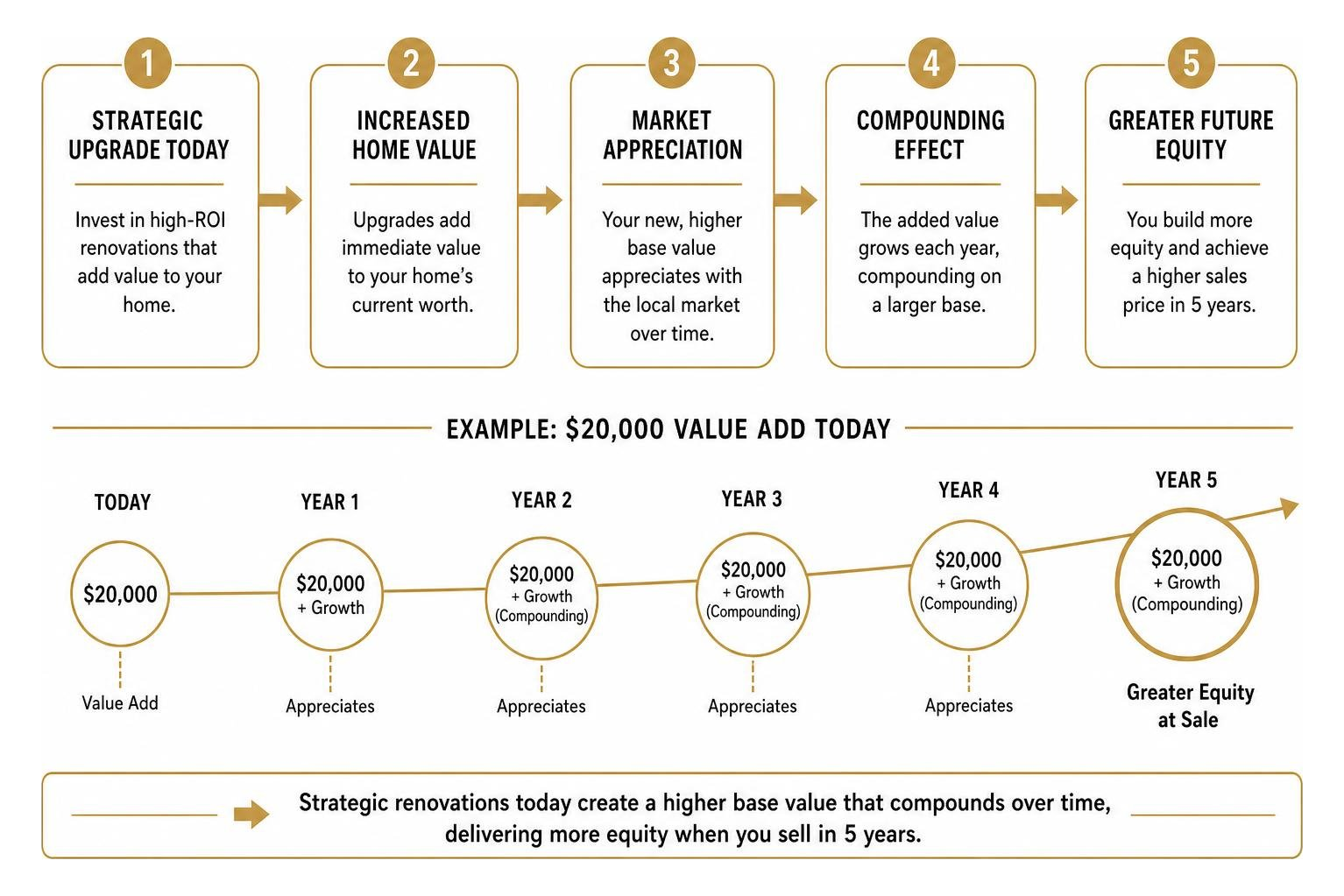
When planning upgrades, keep in mind that these investments also compound. An upgrade that adds $20,000 in base value today doesn’t just sit there; that extra value appreciates at your local market rate over the next five years, compounding into even greater equity when you eventually sell.
To ensure you are prioritizing the right projects for our local market, check out our comprehensive Ultimate Checklist for Lake Nona Real Estate.
Frequently Asked Questions About Future Home Values
What is the average annual home appreciation rate in the U.S.?
Historically, the national average home appreciation rate in the United States has hovered between 3.5% and 5.0% per year over the past few decades, with the 10-year national average sitting at approximately 4.3%.
However, real estate is highly regional. Rural and small-town areas often average only 1.5% to 3.0% annual growth, while high-demand coastal and sunbelt markets frequently see sustained annual appreciation rates of 5.5% to 8.0% or higher.
To explore these national baselines further, you can play with different regional inputs using the Future Home Value Calculator | Estimate Property Appreciation 2026. For those looking even further down the road, it can also be helpful to compare these 5-year goals against longer-term trends using resources like How Much Will My House Be Worth in 10 Years?.
How do school ratings affect a home’s 5-year value?
School ratings are one of the most reliable predictors of long-term neighborhood stability and appreciation. On average, homes located within top-rated school districts appreciate 2% to 5% faster each year than comparable homes in lower-rated districts.
Even during economic downturns, homes in excellent school districts tend to hold their value much better because there is a constant influx of new families looking to move into the area. In places like Lake Nona, the exceptional reputation of local schools acts as a built-in insurance policy for your home equity.
Can a home depreciate in value over a 5-year period?
Yes, real estate values can fluctuate, and appreciation is never guaranteed. During major economic downturns, such as the 2008 financial crisis, home values in some overbuilt or highly speculative markets dropped by 20% to 30% or more.
To manage this risk over a five-year horizon, focus on buying in areas with strong, diversified local job markets, high barriers to entry for new construction, and excellent school districts. Buying a home with the intention of holding it for at least five years generally provides a solid buffer against short-term market corrections.
Conclusion: Take the Guesswork Out of Your Real Estate Future
Estimating your home’s future value isn’t about finding a magic number; it’s about evaluating historical data, understanding local economic drivers, and making strategic choices to protect and build your equity. Whether you are planning to sell in 2031 or looking to purchase a home today that will build a secure financial foundation for your family, having a clear, realistic projection is key.
Because online algorithms cannot see your home’s upgrades or understand the unique lifestyle appeal of our Central Florida neighborhoods, the best way to plan for the future is with a personalized, professional analysis.
At Marketing Moves Homes, we combine deep analytical market data with advanced, modern marketing strategies to help our clients make informed, highly profitable real estate decisions. We live, work, and sell here, and we would love to help you map out your financial future.
If you are ready to find a property poised for excellent long-term appreciation, or if you want a highly accurate valuation of your current home, explore how we can help you Buy a Home with confidence, or contact us today for a custom valuation.