
How to Calculate Net Seller Proceeds in 5 Easy Steps
How to Calculate Net Seller Proceeds in 5 Easy Steps
Know Your Estimated Home Sale Net Proceeds
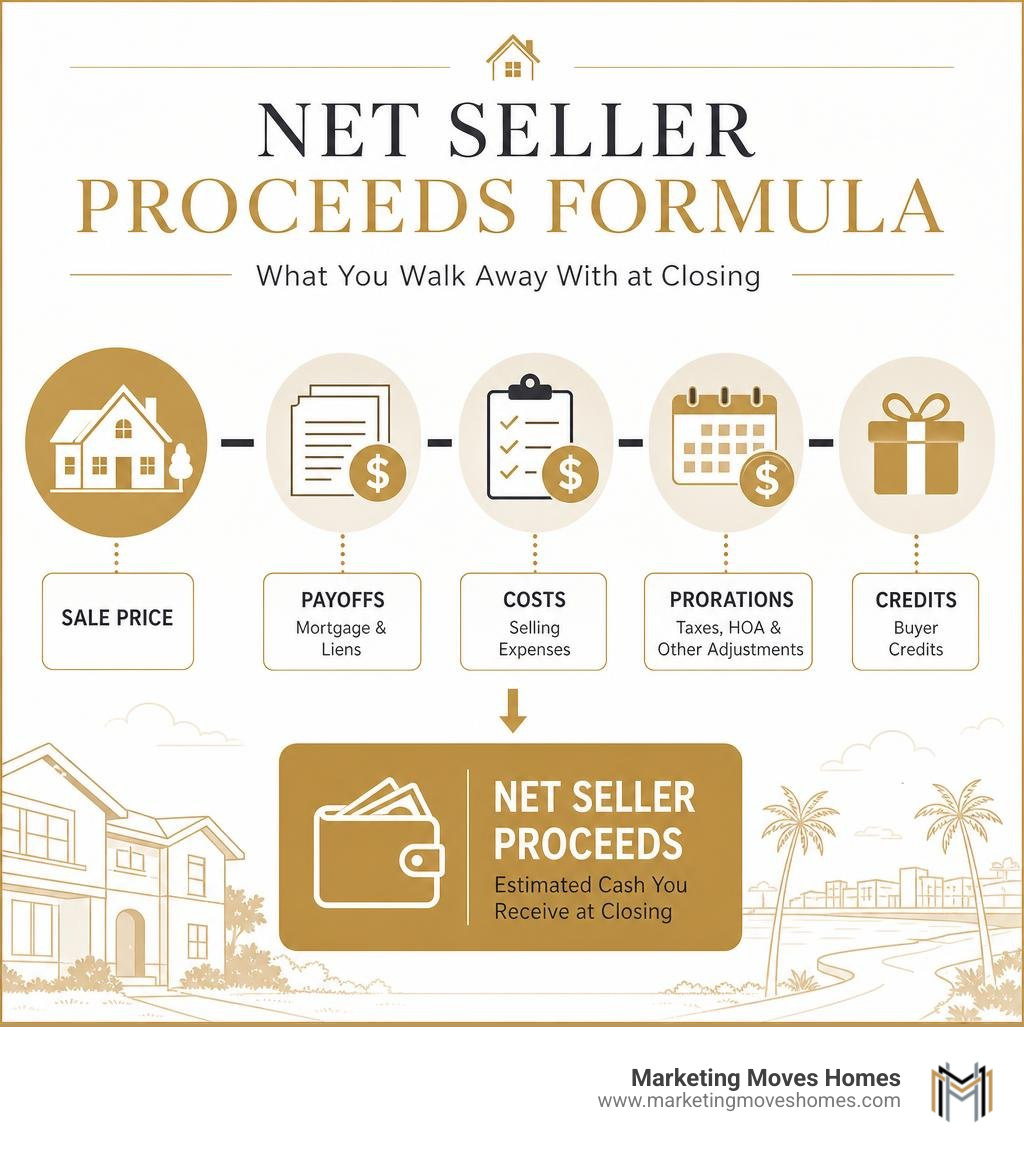
A seller net proceeds calculator estimates the cash you may receive after your home’s sale price is reduced by your mortgage payoff, seller-paid closing expenses, property tax adjustments, HOA-related charges, and any negotiated buyer credits.
Quick formula:
Estimated net proceeds = Sale price – mortgage and lien payoffs – selling expenses – prorations – seller credits
For Lake Nona and Central Florida homeowners, this estimate matters long before closing. It helps you set a realistic next-home budget, compare offers based on the amount you keep rather than the headline price, and avoid surprises when the final settlement statement arrives. It is an estimate, not a guarantee: the final amount can change with the closing date, official lender payoff, and contract terms.
I am Scott Brazdo, MBA, a Lake Nona REALTOR® and co-founder of Marketing Moves Homes, with more than 15 years of Central Florida real estate and marketing experience. I use a seller net proceeds calculator approach to help homeowners in the 32827 and 32832 ZIP codes understand their likely walk-away cash before making important selling decisions.
Step-by-Step: How to Calculate Net Proceeds in 5 Easy Steps
Calculating your estimated walk-away cash does not require an advanced accounting degree, but it does require attention to detail. When evaluating the financial outcome of your home sale, relying on top-line sales prices or automated online valuation estimates can lead to inaccurate expectations. Automated models cannot account for custom interior finishes, home upgrades, local community nuances, or the line-item closing expenses unique to Florida real estate transactions.
To establish a clear financial picture, we recommend breaking the calculation down into a structured 5-step process. A customized seller net sheet prepared with local professional guidance helps ensure that every contractual fee, statutory tax, and lender payoff is accounted for before you enter negotiations.
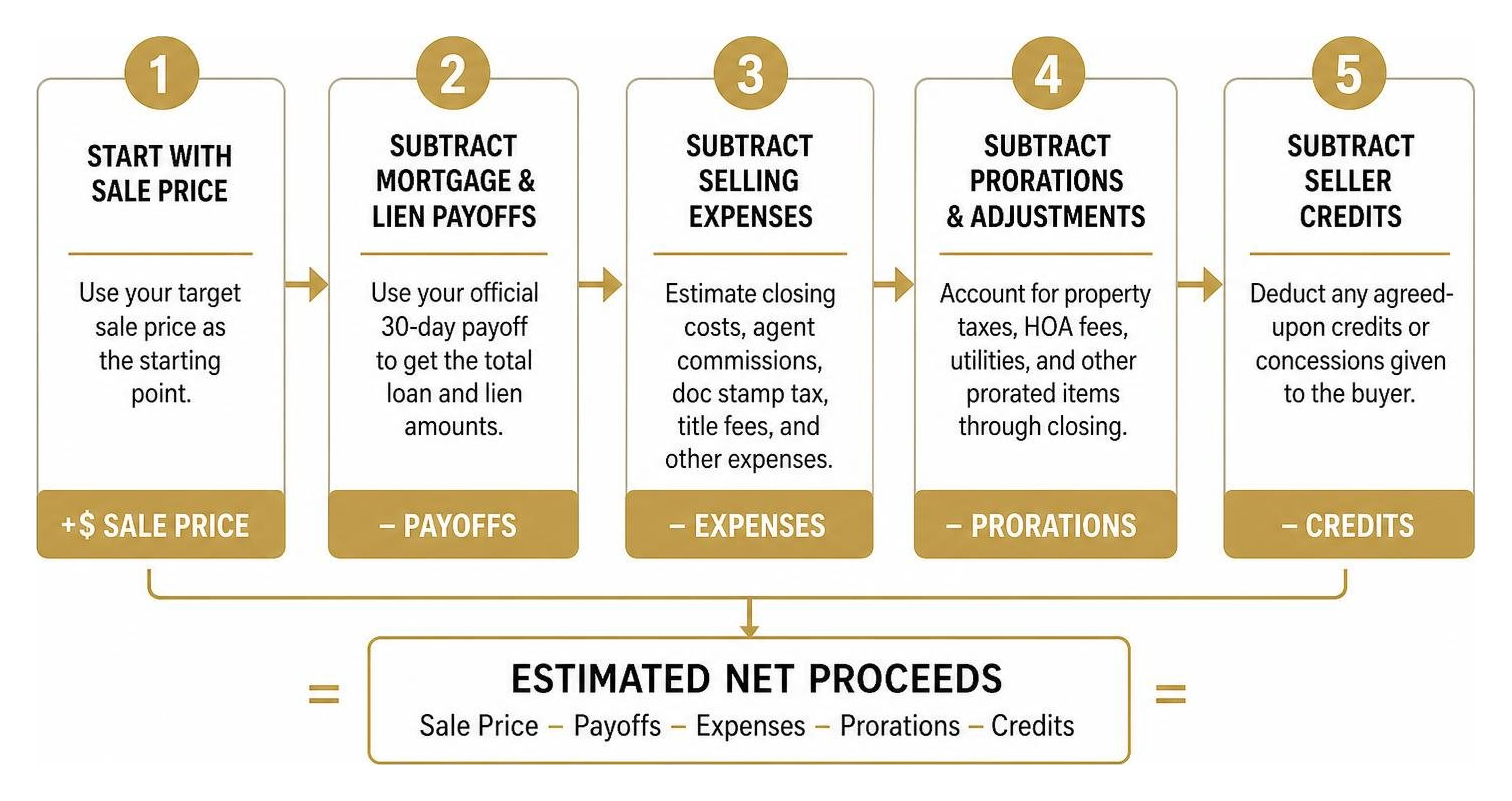
Here is a breakdown of the 5 key steps to determine your estimated home sale proceeds:
- Step 1: Start with Your Target Sale Price – Establish a realistic baseline based on local market dynamics.
- Step 2: Request an Official 30-Day Mortgage Payoff Statement – Identify total loan obligations, including accrued daily interest.
- Step 3: Estimate Florida Closing Costs and Documentary Stamp Taxes – Account for state deed taxes, title insurance, and settlement fees.
- Step 4: Subtract Seller Concessions, Repair Credits, and HOA Estoppel Fees – Factor in buyer incentives, inspection agreements, and HOA requirements.
- Step 5: Deduct Prorated Property Taxes and Final Settlement Fees – Calculate property tax adjustments through the exact day of closing.
Step 1: Start with Your Target Sale Price
The foundation of any net proceeds calculation is the target sale price or agreed contract price. While it is tempting to pick an optimistic number based on general neighborhood trends, an accurate calculation requires a detailed Comparative Market Analysis (CMA) tailored specifically to your immediate community.
In master-planned communities across Lake Nona—such as Laureate Park, Storey Park, VillageWalk, or Eagle Creek—home values vary based on floor plans, lot placements, water views, builder series, and solar or technological upgrades. Pricing your home strategically involves evaluating recent comparable sales, active inventory competition, and buyer demand trends.
Starting with an accurate, market-tested valuation ensures your downstream calculations reflect what the Orlando market will actually support, giving you a reliable benchmark for calculating your walk-away cash.
Step 2: Request an Official 30-Day Mortgage Payoff Statement
The single largest deduction from your gross sale price is typically your existing mortgage payoff balance. A common mistake homeowners make is using the outstanding principal figure listed on their monthly mortgage statement.
Your monthly principal balance does not reflect the total amount required to fully satisfy the loan at closing. To get an accurate figure, you need to request a formal 30-day mortgage payoff statement from your lender. This statement includes several critical adjustments:
- Accrued Daily Interest (Per-Diem Interest): Mortgages accrue interest daily in arrears. Your lender calculates interest from the first day of the current billing cycle up to the exact day the payoff funds are wired and credited.
- Second Mortgages and HELOCs: If you have an active Home Equity Line of Credit (HELOC) or second mortgage, both liens must be fully paid off and satisfied at closing. HELOCs often require a formal freeze request to prevent further draws prior to settlement.
- Lender Release and Recording Fees: Lenders typically charge administrative fees to prepare, process, and record the satisfaction of mortgage document in the public records of Orange County.
Timing your closing date toward the end of a calendar month can slightly reduce the accrued per-diem interest listed on your payoff statement, maximizing your final cash position.
Step 3: Estimate Florida Closing Costs and Documentary Stamp Taxes
State conventions and statutory regulations govern real estate closing expenses in Florida. Understanding these itemized deductions allows you to calculate your net proceeds accurately without closing table surprises.

Key closing cost considerations for Central Florida sellers include:
- Florida Documentary Stamp Tax on Deeds (F.S. § 201.02): Florida charges a state transfer tax on real estate conveyances. In Orange County and across Central Florida (excluding Miami-Dade), the seller customarily pays documentary stamp taxes calculated at $0.70 per $100 of the total purchase price (or portion thereof).
- Owner’s Title Insurance Policy (F.S. § 627.7825): Pursuant to standard Central Florida contract practices, the party responsible for selecting the title agent customarily pays for the Owner’s Title Insurance Policy. The state of Florida regulates title insurance rates based on a tiered sale price scale.
- Settlement and Closing Agent Fees: Title companies and closing attorneys charge administrative fees to conduct the title search, examine public records, prepare legal documents, hold funds in escrow, and facilitate settlement.
- Deed Preparation and Recording Fees: Fees associated with drafting legal conveyance documents and filing the deed in the public records.
Professional representation and strategic marketing play a key role during this phase. An expert listing agent provides comprehensive marketing exposure—using professional photography, videography, and targeted buyer outreach—to attract strong offers, negotiate favorable contract terms, and protect your bottom line throughout settlement.
Step 4: Subtract Seller Concessions, Repair Credits, and HOA Estoppel Fees
Contract negotiations often include items beyond the baseline purchase price and standard closing costs. Depending on market conditions, buyer financing requirements, and home inspection findings, additional line-item deductions may apply:
Seller Concessions and Rate Buy-Downs
To assist buyers with their upfront financing requirements or interest rate structures, sellers may agree to provide a seller credit at closing. These agreed-upon credits reduce your net walk-away cash dollar-for-dollar. Evaluating the net impact of an offer with concessions versus a clean offer at a lower purchase price is critical during offer review.
Inspection Repair Allowances
Following professional home inspections, buyers may request repairs or financial credits in lieu of contractor work. Providing a direct closing credit is often easier to manage than overseeing pre-closing contractor repairs, but it directly impacts your final net calculation.
HOA Estoppel Certificates and Transfer Charges
In Lake Nona’s master-planned neighborhoods, almost all properties belong to single or multi-tiered Homeowners Associations (HOAs) or Condominium Associations. Florida law requires closing agents to order an official HOA Estoppel Certificate to confirm current dues, delinquent balances, pending special assessments, and capital contribution fees.
The HOA charges an estoppel fee to prepare this legally binding statement. Additionally, some communities require administrative transfer fees or buyer capital contributions at closing.
Step 5: Deduct Prorated Property Taxes and Final Settlement Fees
The final step in calculating your net seller proceeds involves prorating ongoing property expenses up through the date of closing.
In Florida, ad valorem property taxes are paid in arrears. Annual tax bills are issued by the Orange County Tax Collector in November for the current calendar year. Because property taxes cover the entire calendar year from January 1 through December 31, tax prorations are calculated at closing pursuant to Florida Statute § 197.0734:
- Closing Before November: If you close before annual tax bills are released, the seller gives the buyer a credit on the settlement statement for the seller’s portion of taxes earned from January 1 up to the day before closing. This calculation uses the prior year’s gross tax bill as a baseline (accounting for maximum early payment discounts).
- Closing After November: If taxes for the current year have already been paid in full prior to closing, the buyer reimburses the seller for the buyer’s prorated share of taxes from the closing date through December 31.
Similar daily prorations apply to monthly or quarterly HOA assessment payments, ensuring both parties pay only for their exact timeframe of ownership.
How an Online Seller Net Proceeds Calculator Works
An online seller net proceeds calculator works by combining user-entered transaction inputs with built-in financial formulas and regional fee customs. Rather than relying on simple back-of-the-envelope calculations, an interactive calculator structures every line item according to standard settlement disclosure formats.

When using an online calculator, you input basic details like expected sale price, outstanding mortgage balance, estimated closing date, and annual property taxes. The tool then applies Florida-specific formulas—such as state documentary stamp tax rates and standard title premiums—to produce an itemized summary of your transaction deductions.
Instead of relying on outside calculator websites, work with a local Lake Nona real estate professional who can prepare a property-specific seller net sheet using your expected sale price, mortgage payoff, Florida closing costs, HOA details, tax prorations, and negotiated contract terms.
Why You Should Use a Seller Net Proceeds Calculator
Utilizing a seller net proceeds calculator early in your home selling journey provides several practical advantages:
- Clear Financial Expectations: It separates top-line gross numbers from true walk-away profit, preventing financial miscalculations before you list.
- Objective Offer Evaluation: When receiving multiple buyer offers, a net sheet allows you to evaluate competing proposals based on bottom-line net yield rather than headline purchase price alone. An offer with a higher purchase price that includes substantial seller credits may net you less cash than a lower, clean offer.
- Accurate Next-Home Budgeting: If you plan to sell your Lake Nona home and buy another property nearby, knowing your exact net proceeds establishes the cash down payment you will have available for your next purchase.
- Strategic Negotiation Power: Understanding your exact baseline allows you to make informed decisions during repair negotiations, contract counter-offers, and seller credit requests.
If you are planning your next transaction in Central Florida, visit our Contact page to request a customized net sheet analysis for your property.
Comparing Estimated Results from a Seller Net Proceeds Calculator to Closing Disclosures
It is important to understand the relationship between an initial seller net sheet estimate and the official Closing Disclosure (CD) or ALTA Settlement Statement provided before closing.
| Financial Tool | Primary Purpose | Timing | Level of Precision |
|---|---|---|---|
| Seller Net Sheet Calculator | Pre-listing financial planning and offer comparison | Before listing or during contract negotiation | Ballpark estimate based on preliminary inputs |
| Official Closing Disclosure (CD) | Legally binding settlement statement required by federal law | Provided 3 business days prior to closing | Exact line-item accounting of final settlement funds |
While an online net sheet gives you a strong planning baseline, final numbers on the Closing Disclosure may fluctuate slightly due to the exact closing date, daily interest recalculations, finalized HOA estoppel fees, and municipal lien search results. Reviewing your estimated net sheet against the preliminary closing statement provided by your title agent ensures complete transparency prior to signing final documents.
Understanding Gross Equity vs. Net Proceeds in Central Florida
Many homeowners confuse gross home equity with net walk-away proceeds. Understanding the difference between these two concepts is crucial when evaluating your financial position in the Central Florida market.
- Gross Equity: Gross equity is simply the estimated market value of your property minus your remaining principal mortgage balance. It represents your raw, unadjusted ownership stake on paper.
- Net Proceeds: Net proceeds represent the actual cash transferred into your bank account after all selling expenses, loan satisfaction fees, statutory taxes, prorations, and negotiated contract credits are fully subtracted from the sale price.
To visualize how transaction deductions impact your bottom line, consider the following comparative scenario for a representative single-family home in the Lake Nona area (32827/32832 ZIP codes):
| Financial Category | Gross Equity Calculation | Net Proceeds Calculation |
|---|---|---|
| Agreed Home Sale Price | Baseline Valuation | Baseline Valuation |
| Mortgage Balance Deduction | Subtract Principal Loan Balance | Subtract Full 30-Day Loan Payoff (Principal + Per-Diem Interest) |
| Florida Documentary Stamp Tax | Not Included | Subtracted (F.S. § 201.02) |
| Title Policy & Escrow Fees | Not Included | Subtracted |
| Seller Concessions & Repair Credits | Not Included | Subtracted |
| Orange County Property Tax Prorations | Not Included | Subtracted (F.S. § 197.0734) |
| HOA Estoppel & Resale Fees | Not Included | Subtracted |
| Final Result | Gross Paper Equity | Actual Walk-Away Cash |
As shown above, relying on gross equity figures alone can create an accurate baseline for paper wealth, but only a complete net proceeds calculation reveals your true walk-away capital. This distinction is especially critical for move-up buyers looking to purchase another home in Central Florida. You can explore available homes and plan your transition by visiting our Buy a Home search platform.
Frequently Asked Questions About Home Sale Net Proceeds
What is the difference between gross equity and net walk-away proceeds?
Gross equity is the difference between your home’s gross market value and your remaining mortgage principal balance. Net walk-away proceeds are the actual cash funds you receive after subtracting all seller-paid closing expenses, official loan payoff balances (including daily interest), state documentary stamp taxes, title/escrow fees, property tax prorations, HOA estoppel costs, and negotiated buyer credits. Net proceeds represent your true liquid cash yield at settlement.
How do prorated property taxes in Orange County affect my net proceeds?
In Orange County, property taxes are billed in arrears every November for the current calendar year. Under Florida Statute § 197.0734, property taxes are prorated at closing based on the calendar year. If you close before tax bills are issued in November, you provide the buyer with a credit for the property taxes owed from January 1 up through the day before closing. If you close after taxes have been paid in November, the buyer reimburses you for their portion of taxes from the closing date through December 31.
Are net proceeds estimates guaranteed prior to closing?
No, estimates generated by an online seller net proceeds calculator or pre-listing net sheet are planning tools, not legal guarantees. Final proceeds are determined by the settlement agent on the official Closing Disclosure or ALTA Settlement Statement. Factors that can alter final proceeds include changes to the closing date (which changes daily mortgage interest and tax prorations), final HOA estoppel charges, updated lender payoff figures, and contract amendments negotiated during inspection periods.
Conclusion
Calculating your net seller proceeds is one of the most important financial steps you can take when preparing to sell your home. By looking beyond headline sales prices and understanding how mortgage payoffs, Florida transfer taxes, title fees, HOA estoppels, and tax prorations come together, you can make confident, informed decisions for your household.
In the fast-growing Lake Nona market—spanning the 32827 and 32832 ZIP codes—having a dedicated local real estate expert by your side makes all the difference. At Marketing Moves Homes, we combine deep community knowledge with targeted digital marketing, high-definition videography, professional staging guidance, and strategic price positioning to help our sellers maximize their net walk-away cash and sell efficiently.
If you are thinking about selling your Central Florida home and want a clear, accurate financial breakdown tailored to your property, visit our List My Home page today to request a professional home valuation and personalized net sheet review.