The Ins and Outs of Home Value Estimates
The Ins and Outs of Home Value Estimates
Find the Best Home Estimate for Your Central Florida Property
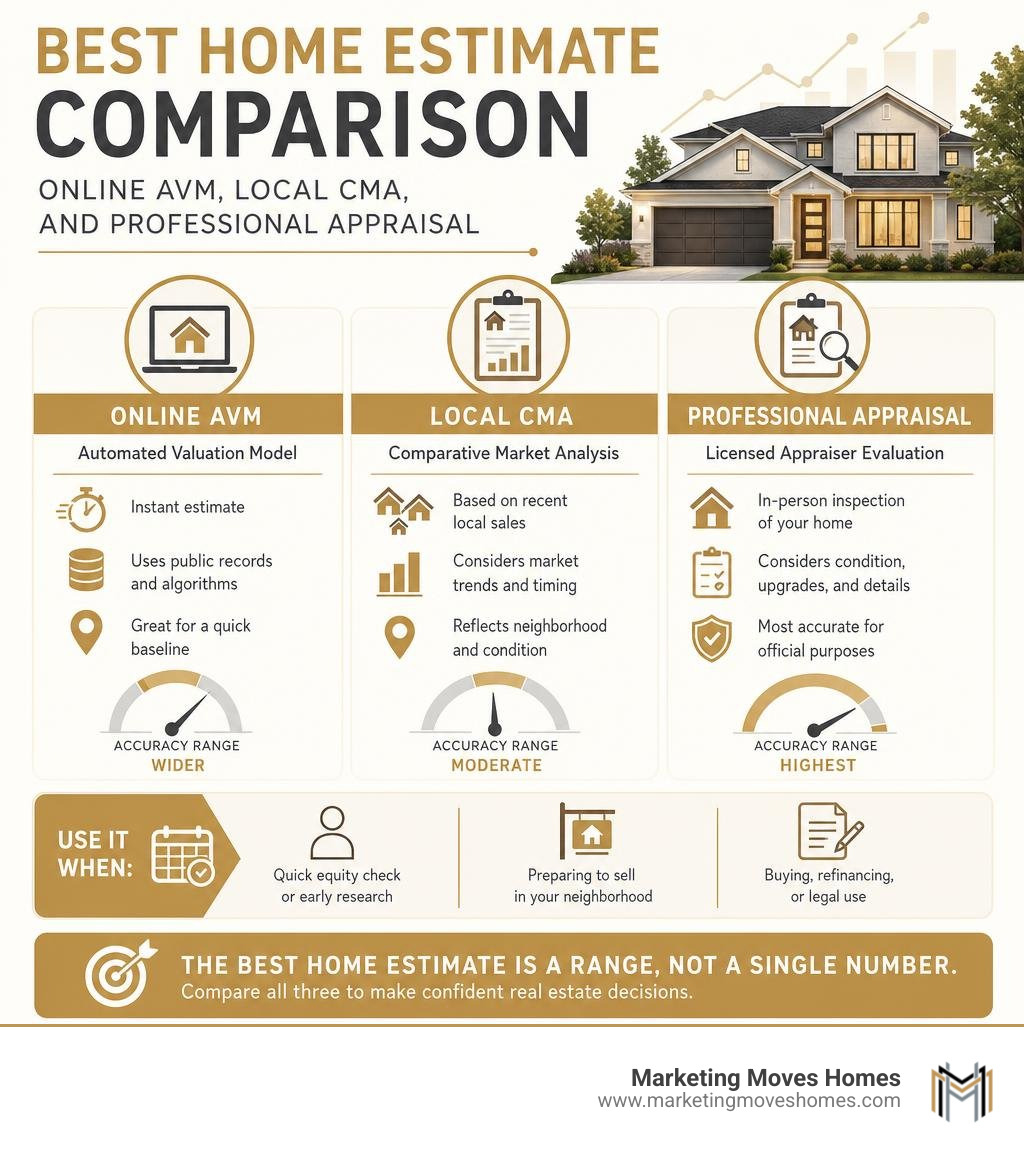
The best home estimate is not one number from a single online algorithm. It is a realistic value range built by evaluating recent local sales, neighborhood trends, and the condition of your specific home.
| For your goal | Best starting point |
|---|---|
| Quick equity check | Request a preliminary local valuation consultation |
| Preparing to sell in Lake Nona | Request a local comparative market analysis (CMA) |
| Buying, refinancing, or legal use | Get a licensed professional appraisal |
Online tools use automated valuation models, or AVMs. They review public records, home facts, listing data, and nearby sales. That makes them useful for a fast baseline, especially in data-rich areas such as Lake Nona’s 32827 and 32832 ZIP codes. But they cannot walk through your home, see a remodeled kitchen, judge its upkeep, or fully measure what buyers want in a specific neighborhood.
That is why automated estimates can vary widely across platforms. Each model uses different data, timing, and rules for choosing comparable homes. The strongest answer combines technology with current, local market context.
I am Scott Brazdo, MBA, a Lake Nona REALTOR(R) and co-founder of Marketing Moves Homes, with more than 30 years of marketing experience and years of residential real estate work across Central Florida. I help sellers and buyers put a best home estimate in context through local property knowledge, professional listing strategy, and a clear view of what today’s buyers value.
How Automated Valuation Models Work to Deliver the Best Home Estimate
When you enter an address into an online calculator, an Automated Valuation Model (AVM) instantly processes millions of data points to generate what it projects as the market value. Modern computer algorithms and neural network architectures analyze public tax assessor records, historical transaction trends, and active Multiple Listing Service (MLS) feeds. These digital tools analyze home characteristics like total square footage, lot size, bedroom count, and the age of the structure against recently sold properties nearby.
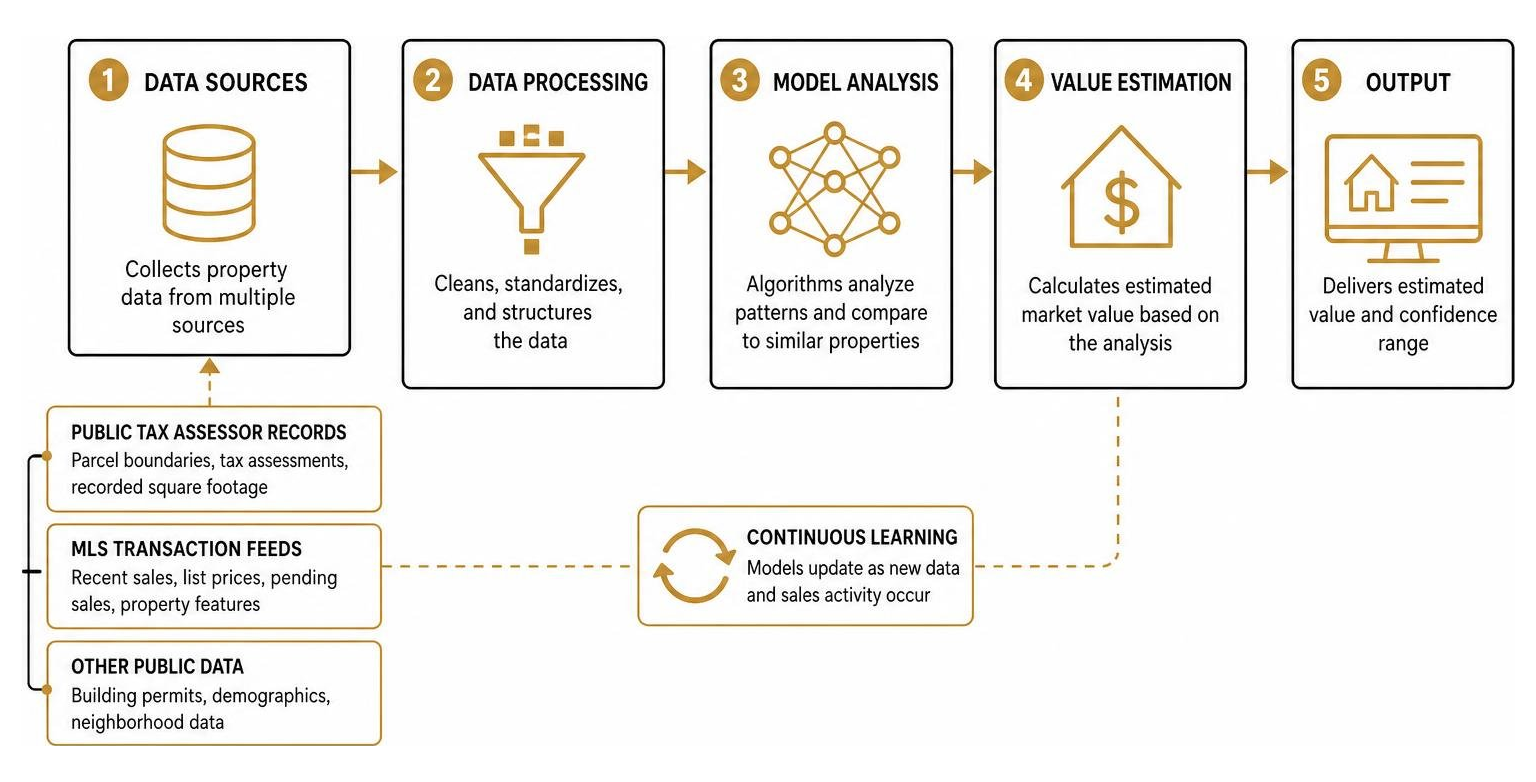
However, algorithmic predictions can vary dramatically. Automated models rely purely on numeric inputs. They calculate averages based on geographic proximity and public documentation, but computer software cannot evaluate micro-market shifts or interior property condition.
| Feature / Metric | Public Tax Assessor Records | MLS Transaction Feeds | Automated Valuation Models (AVMs) |
|---|---|---|---|
| Primary Data Points | Parcel boundaries, tax assessments, recorded square footage | Recent sales, list prices, pending sales, property features | Aggregated public records, MLS comps, historical trends |
| Update Frequency | Annually or upon official permit updates | Daily or real-time | Weekly to monthly mathematical cycles |
| Primary Limitation | Often misses unpermitted or unrecorded upgrades and interior condition | Limited to properties represented by licensed agents | Missing physical interior condition and neighborhood nuances |
Understanding Data Sources and Algorithmic Variance
Automated valuation tools are only as accurate as the public data feeding into them. Across Central Florida, municipal tax assessor databases provide the foundational layer for automated estimates. Yet, public records frequently contain inaccuracies or omissions regarding core property details like bed and bath counts.
If a homeowner finishes a garage conversion or remodels a kitchen without immediately triggering a reassessment, the software remains completely unaware of those upgrades. Consequently, the calculated online valuation reflects outdated property facts.
Furthermore, algorithms struggle with geographic nuance. An automated model might treat a home near a bustling commercial hub in Downtown Orlando the exact same as a residence located on a quiet interior street in Lake Nona’s 32827 ZIP code simply because they share a similar age and square footage. Without human oversight, automated systems frequently miscalculate how hyper-local factors impact buyer demand.
Choosing the Best Home Estimate Tool for Your Property

When homeowners seek to determine their property’s equity, relying solely on third-party online estimate sites can yield misleading results. Statistical analyses demonstrate that digital algorithms experience significantly higher median error rates on off-market homes compared to active listings. On-market properties benefit from live pricing feedback and active MLS photos, whereas off-market estimates rely on stale municipal records.
Because automated calculators cannot account for custom builder finishes, recent mechanical updates, or premier lot placements, third-party online valuations often produce wide price swings. To establish a true best home estimate in competitive Central Florida markets like Lake Nona, Dr. Phillips, or Winter Park, automated numbers must serve merely as a preliminary digital snapshot rather than a final listing benchmark.
Comparing Valuation Methods: AVMs, CMAs, and Appraisals
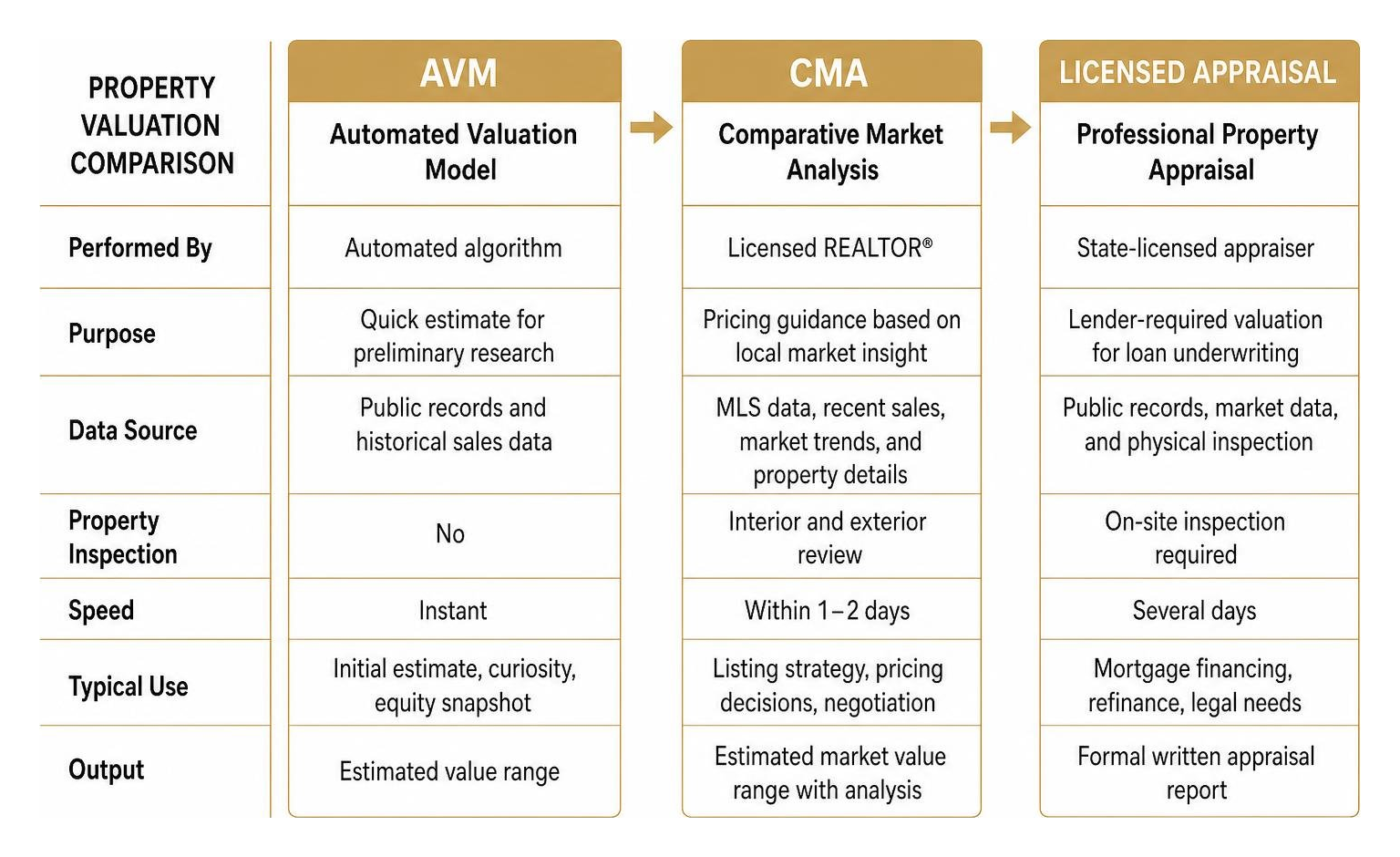
Understanding your home’s true value requires knowing which tool fits your specific situation. Homeowners generally encounter three primary valuation formats:
- Automated Valuation Models (AVMs): Digital computer calculations aggregating public sales data for fast preliminary research.
- Comparative Market Analysis (CMA): An in-depth, localized market study completed by a professional REALTOR® that evaluates property condition, physical upgrades, and active buyer demand.
- Professional Property Appraisal: A formal, licensed valuation required by mortgage lenders to underwrite home loans and confirm collateral value.
For a long-term view of equity trends, exploring How to Estimate House Value in 5 Years Without a Crystal Ball offers strategic insights into broader market cycles.
AVM vs. CMA vs. Appraisals
Each valuation method fulfills a distinct role during your homeownership journey:
- Speed and Accessibility: AVMs deliver instant results, making them helpful for casual, high-level curiosity.
- Local Market Nuance: A CMA provided by our team at Marketing Moves Homes incorporates real-time local dynamics across Lake Nona, College Park, and Windermere. We evaluate interior condition, recent structural updates, school zone boundaries, and unique community amenities.
- Mortgage Underwriting: Financial institutions do not accept automated website estimates to approve mortgage loans or cash-out refinances. Lenders strictly mandate an official appraisal conducted by a state-licensed appraiser who performs an in-person physical property inspection.
Why Online Values Differ Across Platforms
It is common to look up a home across multiple websites and see estimates that differ by tens of thousands of dollars. In fact, property evaluations across different automated platforms frequently yield substantial price differences depending on the algorithm used.
These massive differences occur because each platform uses a distinct proprietary formula. One system might prioritize closed sales within a one-mile radius over the past 90 days, while another looks back six to twelve months across an entire ZIP code. None of these automated models can see interior upgrades, high-end quartz countertops, or custom outdoor living spaces, leading to substantial mathematical gaps between platforms.
Factors Influencing Property Valuation in Central Florida

Central Florida real estate values depend heavily on hyper-local economic drivers. While national economic trends like interest rate movements influence general housing affordability, local factors dictate actual market performance in specific neighborhoods.
Location demand remains a dominant driver. For example, homes located within prime Lake Nona communities (ZIP codes 32827 and 32832) often command strong demand due to proximity to Medical City, top-rated schools, and modern infrastructure. Across Central Florida, distinct lifestyle preferences, urban accessibility, lakefront amenities, and neighborhood-specific buyer demand directly influence local offer strength.
Key Drivers of Home Market Value
When evaluating what truly sets your home apart from surrounding properties, several key drivers come into play:
- Usable Square Footage & Floor Plan Layout: Total living area matters, but functional layout is equally important. Open-concept living spaces, dedicated home offices, and split-bedroom plans enhance overall usability.
- Bedroom and Bathroom Counts: Adding a functional bedroom or updating a bath can shift valuation significantly.
- Property Condition & System Upgrades: Homes with recently replaced roofs, updated HVAC systems, and modern energy-efficient windows consistently outpace properties with deferred maintenance.
- Curb Appeal and Outdoor Living: First impressions strongly influence offer strength. Well-landscaped yards and screened lanai spaces add tangible appeal in Central Florida’s climate.
- Localized Supply and Demand: Inventory levels within a specific subdivision directly dictate pricing power. Low inventory in desirable pockets like Lake Nona or Winter Park supports higher valuation baselines.
How to Use the Best Home Estimate to Increase Property Value
Once you establish a realistic baseline valuation range, strategic property improvements can help unlock additional equity before putting your home on the market. Focusing budget on high-impact projects yields the strongest return:
- Focus on the Kitchen and Bathrooms: Kitchen condition is frequently the single highest-impact room variable for buyers. Updating cabinetry hardware, refreshing countertops, and installing modern appliances can dramatically elevate buyer interest.
- Elevate Curb Appeal: Landscaping enhancements, power washing exterior surfaces, and applying a fresh coat of paint to the front entrance create an immediate positive reaction during the initial seconds of a home showing.
- Maintain Core Systems: Structural integrity and operational mechanicals—such as a dependable roof, clear plumbing, and efficient cooling systems—prevent value deductions during buyer inspections.
When you are ready to transition from valuation research to active market exposure, partner with us to List My Home using high-end photography, targeted digital campaigns, and expert local representation.
Frequently Asked Questions About Home Estimates
Can I use an online estimate to get a loan or set my listing price?
No. Mortgage lenders and financial institutions require a formal property appraisal conducted by a certified, licensed appraiser to approve loan applications or refinancing packages. Furthermore, setting a listing price purely based on a third-party website estimate can cause you to either underprice your property or overprice it, causing the listing to linger on the market. An accurate listing strategy requires a comprehensive CMA prepared by a local REALTOR®.
What should I do if my estimated home value seems inaccurate?
If an online estimate for your home seems noticeably too low or too high, start by reviewing public tax assessor records for accurate bedroom counts, bathroom counts, and total square footage. You can contact your county property appraiser’s office to correct municipal discrepancies. To obtain an exact, reliable market price that reflects your home’s unique interior upgrades and local condition, request a localized pricing consultation from our team.
How often do home estimates update and why do values fluctuate?
Online valuation models typically refresh their databases weekly or monthly as new public records and MLS sales close. Estimates fluctuate continuously due to shifting local interest rates, seasonal buyer activity, changes in neighborhood inventory, and recent comparable sales closed within the preceding three to six months. In healthy, balanced real estate markets, residential property values historically trend upward at a steady, sustainable pace.
Conclusion
Finding the best home estimate requires bridging digital calculations with real-world local market expertise. While online tools offer a convenient starting point for general market curiosity, they lack the capacity to evaluate interior finishes, architectural enhancements, and hyper-local buyer momentum across Central Florida.
At Marketing Moves Homes, we combine deep local roots in Lake Nona (32827 and 32832) and surrounding Central Florida communities with high-impact listing strategies—including professional media, video tours, and targeted marketing—to position your property for maximum return. Whether you are planning to sell, searching for your next home, or simply navigating your current equity options, having an experienced local REALTOR® by your side ensures you make confident, informed financial choices.
When you are ready for guidance tailored to your neighborhood, reach out to us to Explore top Central Florida real estate options and market guidance and discover what your home is truly worth in today’s market.