
How to Calculate Net Proceeds from a Sale with a Seller Net Sheet
How to Calculate Net Proceeds from a Sale with a Seller Net Sheet
What Is a Seller Net Sheet and Why Is It Essential?
To calculate net proceeds from a home sale using a seller net sheet, start with the gross contract sales price and systematically deduct mortgage payoffs (including per-diem interest), professional brokerage fees, state transfer taxes, title and settlement charges, daily property tax and HOA prorations, and any negotiated repair or closing credits. The remaining balance represents your estimated walk-away cash at settlement.
When selling your home in Lake Nona, Dr. Phillips, or Windermere, a seller net sheet bridges the gap between top-line offer numbers and the actual direct deposit entering your bank account on closing day. Selling residential property involves several unavoidable transactional expenses, municipal lien searches, and statutory fees. Without an itemized forecast, sellers risk planning their next purchase on inaccurate financial assumptions.
At Marketing Moves Homes, we prepare detailed net sheets during our initial listing consultations to give you financial clarity before your property ever hits the market. Seeing these deductions in advance allows you to evaluate your true equity position, establish a target bottom line, and understand how Lake Nona realtors navigate the closing process for you to protect your equity at every stage of negotiation.
How to Read a Seller Net Sheet Template
A standard net sheet is organized as a financial waterfall that starts with the gross contract price and systematically deducts all transactional costs to arrive at your estimated net proceeds. Understanding each grouping helps you identify which items are fixed by statutory guidelines and which depend on contract terms.
The typical layout includes:
- Gross Transaction Figures: The agreed-upon sales price of the property.
- Existing Encumbrances: The estimated payoff balance for your primary mortgage, second mortgages, or home equity lines of credit (HELOCs).
- Professional Brokerage Fees: The compensation allocated for professional listing representation, marketing exposure, transaction coordination, and buyer representation.
- Government Documentary & Recording Fees: State transfer taxes on the deed, county recording fees, and municipal lien search charges.
- Title and Settlement Charges: Title search fees, settlement closing fees, and owner’s title insurance policy premiums.
- Prorations and Adjustments: Daily prorations for county property taxes, municipal assessments, and neighborhood HOA or master association dues.
- Concessions and Repair Credits: Any negotiated seller credits toward buyer closing costs or post-inspection repair allowances.
Navigating these line items ensures you are fully prepared for settlement. Reviewing A Complete Guide to the Lake Nona Realtor Escrow Process provides additional insight into how escrow officers collect and disburse these exact funds.
Seller Net Sheet vs. Closing Disclosure
While both documents outline the financial elements of your transaction, they serve completely different purposes at distinct stages of the sale:
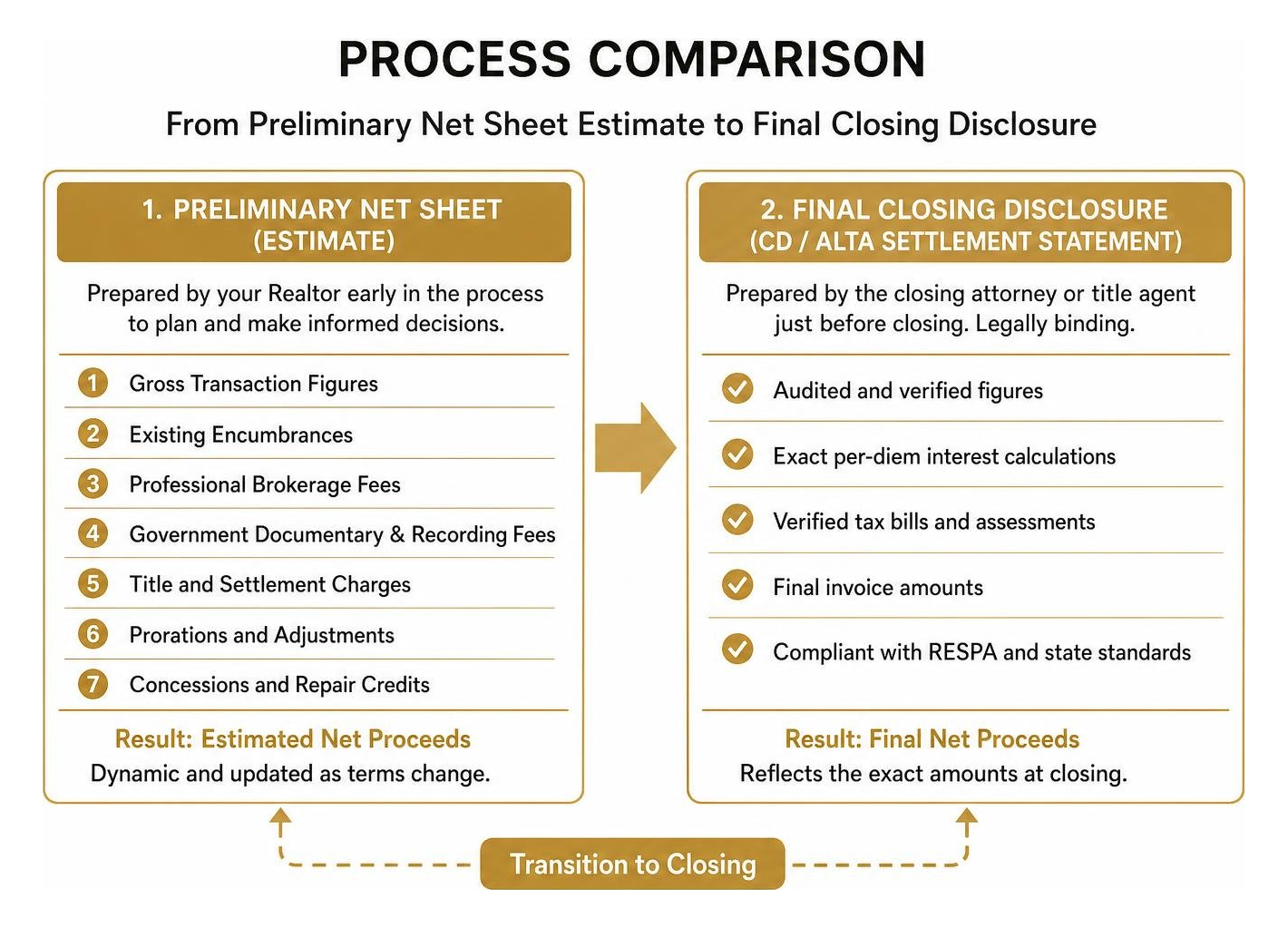
- Seller Net Sheet: A preliminary planning document prepared by your Realtor. It provides an early estimate during initial pricing discussions, offer reviews, or post-inspection negotiations to help you make informed business decisions. It is dynamic, flexible, and updated as terms change.
- Closing Disclosure (CD) / ALTA Settlement Statement: A formal, legally binding document generated by the closing attorney or title settlement agent shortly before the actual closing date. It reflects audited numbers, exact per-diem interest calculations, verified tax bills, and final invoice amounts in compliance with federal RESPA and state closing standards.
Understanding the transition from an early net estimate to the final settlement statement ensures a smooth transaction. You can learn more about mastering this transition by navigating your Lake Nona real estate closing like a pro.
Breaking Down Key Closing Costs and Deductions in Florida
Florida real estate transactions involve a specific set of statutory fees, closing customs, and prorated calculations. Across typical residential transactions, total seller-side deductions (including mortgage payoff, closing costs, and broker fees) often account for a significant portion of the gross sale price.

The Primary Deductions on a Florida Net Sheet
- Mortgage Payoff and Per-Diem Interest: Your actual loan payoff is almost always 0.5% to 1.5% higher than the principal balance shown on your monthly statement. Mortgage interest is paid in arrears, meaning interest accrues daily (per-diem) from the first day of the closing month through the day the lender receives wire payoff funds.
- Florida Deed Documentary Stamp Taxes (F.S. § 201.02): The State of Florida levies an excise tax on documents that transfer interest in real estate. In Orange County and across most of Central Florida, the deed documentary stamp rate is $0.70 per $100 of the gross sales price (or fraction thereof).
- Title Search and Municipal Lien Search: The title company conducts an in-depth examination of public records to ensure clear title, alongside a municipal search to confirm there are no unrecorded code violations, open permits, or utility liens.
- Closing Settlement and Escrow Fees: Title agencies and settlement attorneys charge a flat fee to prepare legal transfer documents, hold escrow deposits, coordinate payoffs, and conduct the closing.
- County Recording Fees: Small statutory charges paid to the county comptroller to record the satisfaction of your existing mortgage and release prior liens.
Title Insurance and County Customary Practices
Title insurance protects property owners and lenders against historical defects, liens, or encumbrances on a property’s title. In Florida, title insurance premium rates are strictly promulgated by the state government under Florida Statute § 627.7825, meaning standard base insurance rates are uniform across all title agencies.
However, who customarily pays for the owner’s title policy depends heavily on local county custom:
- Orange, Seminole, Osceola, and Lake Counties: In our core Central Florida markets—including Lake Nona (ZIP codes 32827 and 32832), Winter Park, and Windermere—the seller customarily pays for the owner’s title insurance policy and selects the closing agent.
- Buyer-Paid Counties: In a handful of Florida counties (such as Miami-Dade, Broward, Sarasota, and Collier), the buyer customarily pays for the owner’s title policy.
When selling in Central Florida, accounting for the owner’s title policy on your net sheet is essential for an accurate projection. For a deeper understanding of coverage types and settlement protection, explore our guide on how to find reliable title insurance: a comprehensive guide.
Prorated Property Taxes and HOA Fees
Property taxes in Florida are paid annually in arrears every November for the calendar year (January 1 through December 31). Because property taxes cover the entire calendar year but are billed toward the end of it, the seller must provide a credit to the buyer for the portion of the year the seller owned the home.
Under Florida Statute § 197.0734, tax prorations are calculated using a 365-day convention:
- Tax Proration Formula:
(Annual Tax Assessment ÷ 365 days) × Number of Days Owned in Calendar Year Prior to Closing - The Proration Credit: If you close on day 180 of the year, you will credit the buyer for 180 days of taxes at closing. When the official tax bill arrives in November, the buyer pays the full annual amount to the county tax collector.
Homeowners Association (HOA) and Master Association Dues:
In master-planned communities across Lake Nona, HOA and CDD (Community Development District) fees are common. Unlike property taxes, HOA dues are typically paid in advance (monthly, quarterly, or semi-annually). If you have already paid your quarterly HOA dues and close midway through that quarter, you receive a prorated credit back from the buyer on the net sheet for the days remaining.
Calculating Net Proceeds: From Gross Equity to Walk-Away Cash
Many homeowners confuse gross equity with net proceeds. Gross equity is simply the estimated market value of your home minus your outstanding mortgage balance. Net proceeds, on the other hand, represent the actual liquid cash remaining after every closing expense, commission, tax proration, and negotiated credit is settled.
The Seller Net Proceeds Formula
Net Proceeds = Gross Sale Price - Mortgage Payoff(s) - Brokerage Fees - Closing & Title Costs - Transfer Taxes - Net Tax/HOA Prorations - Negotiated Buyer Credits
To see how these deductions interact, consider two realistic Central Florida sales scenarios: a master-planned single-family home in Lake Nona and an executive home in Windermere.
| Financial Item | Lake Nona Home Example | Windermere Home Example |
|---|---|---|
| Gross Contract Sale Price | $550,000 | $850,000 |
| Existing Mortgage Payoff (Principal + Per-Diem) | -$265,000 | -$390,000 |
| Professional Brokerage Fees & Representation | -$33,000 | -$51,000 |
| Florida Deed Documentary Stamps ($0.70 / $100) | -$3,850 | -$5,950 |
| Owner’s Title Insurance Policy (Promulgated Rate) | -$2,825 | -$4,075 |
| Settlement, Title Search & Lien Search Fees | -$1,150 | -$1,250 |
| County Recording & Release Charges | -$150 | -$150 |
| Prorated Property Taxes (Closing Day 180 Credit) | -$3,100 | -$5,200 |
| HOA Dues Proration Credit (Paid in Advance) | +$175 | +$225 |
| Negotiated Repair Credits / Buyer Closing Credit | -$2,500 | -$5,000 |
| Estimated Net Walk-Away Cash to Seller | $238,600 | $387,600 |
| Estimated Net Proceeds as % of Sale Price | 43.38% | 45.60% |
As demonstrated in the table, relying solely on gross equity ($550,000 minus $265,000 = $285,000) would overstate the Lake Nona seller’s walk-away cash by more than $46,000. Working with a comprehensive net sheet prevents surprises and ensures you negotiate from an informed financial position.
Forecasting Long-Term Equity and Proceeds
Evaluating your equity position is valuable not only when you are ready to sign a contract, but also when planning multi-year financial goals. Monitoring home equity buildup, local appreciation trends, and principal paydown allows you to time your sale effectively. For strategies on projecting future value based on neighborhood dynamics rather than guesswork, read how to estimate house value in 5 years without a crystal ball.
Handling Potential Shortfalls and Negative Equity
In situations where a property has minimal equity, a recent market adjustment occurs, or multiple secondary liens exist, a seller net sheet may reveal a negative net proceeds figure. This means the total deductions exceed the expected gross sale price.
When net proceeds are negative, the seller has several distinct options:
- Bring Certified Funds to Closing: If the shortfall is manageable, you can bring the required difference in certified bank funds or a wire transfer to satisfy all liens and closing costs at settlement.
- Adjust Pricing Strategy and Timing: If personal timelines permit, postponing the sale allows you to pay down additional mortgage principal and build equity through ongoing market growth.
- Negotiate Debt Payoffs: Some junior lienholders or second-mortgage lenders may consider discounted lump-sum payoffs prior to closing.
- Evaluate a Short Sale: If the property value is significantly lower than the outstanding mortgage debt and you are facing documented hardship, your lender may approve a short sale, accepting less than the full balance owed.
Frequently Asked Questions About Home Sale Net Proceeds
How accurate are online net sheet calculators?
Online automated calculators provide a broad planning estimate, but they often lack precision regarding local market nuances. Automated tools frequently miscalculate local county title insurance payment customs, overlook municipality-specific lien search costs, and fail to account for daily per-diem mortgage interest accrual. Furthermore, online automated estimates can be inaccurate because they miss physical property condition, high-end interior upgrades, hyper-local school zone boundaries, and current micro-market dynamics in Orlando neighborhoods. For an accurate financial picture, request a custom net sheet prepared by a local real estate professional who understands Central Florida closing standards.
Are seller proceeds subject to capital gains taxes at closing?
Title companies and closing agents do not routinely withhold federal capital gains taxes from residential sale proceeds for U.S. citizens at closing. Under IRS Section 121, single homeowners can exclude up to $250,000 of capital gains profit, and married couples filing jointly can exclude up to $500,000, provided the home was their primary residence for at least two of the five years preceding the sale.
However, transactions involving foreign sellers fall under the Foreign Investment in Real Property Tax Act (FIRPTA), which requires mandatory closing-table tax withholdings unless specific statutory exemptions are met. Always consult a certified CPA or tax advisor regarding your specific tax liability.
When should a seller request an updated net calculation?
A seller net sheet is not a one-time document. It should be generated and updated at four critical milestones:
- At the Initial Listing Consultation: To evaluate listing price scenarios and establish realistic walk-away expectations.
- Upon Receiving Any Purchase Offer: To compare competing offers side-by-side, evaluating whether an offer with a higher price but large closing cost concessions nets more or less cash than a clean, lower-priced offer.
- After Home Inspection Negotiations: To evaluate the exact financial impact of proposed repair credits or price adjustments.
- When a Closing Date Changes: Because mortgage per-diem interest and property tax prorations shift with every calendar day, any timeline modification requires an updated calculation.
Conclusion
Successfully selling your home in Central Florida requires strategic marketing to attract premium buyers, paired with precise financial planning to protect your hard-earned equity. A well-prepared seller net sheet removes ambiguity from the transaction, giving you the clarity needed to make confident decisions on listing price, contract terms, and repair requests.
At Marketing Moves Homes, we combine high-impact visual marketing, extensive local neighborhood expertise across Lake Nona and greater Orlando, and detailed transaction management to deliver superior results for our clients. Whether you are selling your primary residence in Lake Nona or an investment home in Central Florida, our team is here to guide you through every calculation and contract milestone.
Ready to see your property’s true market value and custom walk-away projection? Contact Scott Brazdo and our team today to list my home and begin your sale with complete financial confidence.