
A Quick Start Guide to Orlando HOA Rules
A Quick Start Guide to Orlando HOA Rules
Understanding Orlando HOA Rules Before You Buy or Sell
Orlando HOA rules are the binding community standards that can shape how you use, maintain, rent, and change a home in a deed-restricted neighborhood. They are set by each association’s recorded governing documents and must comply with Florida law.
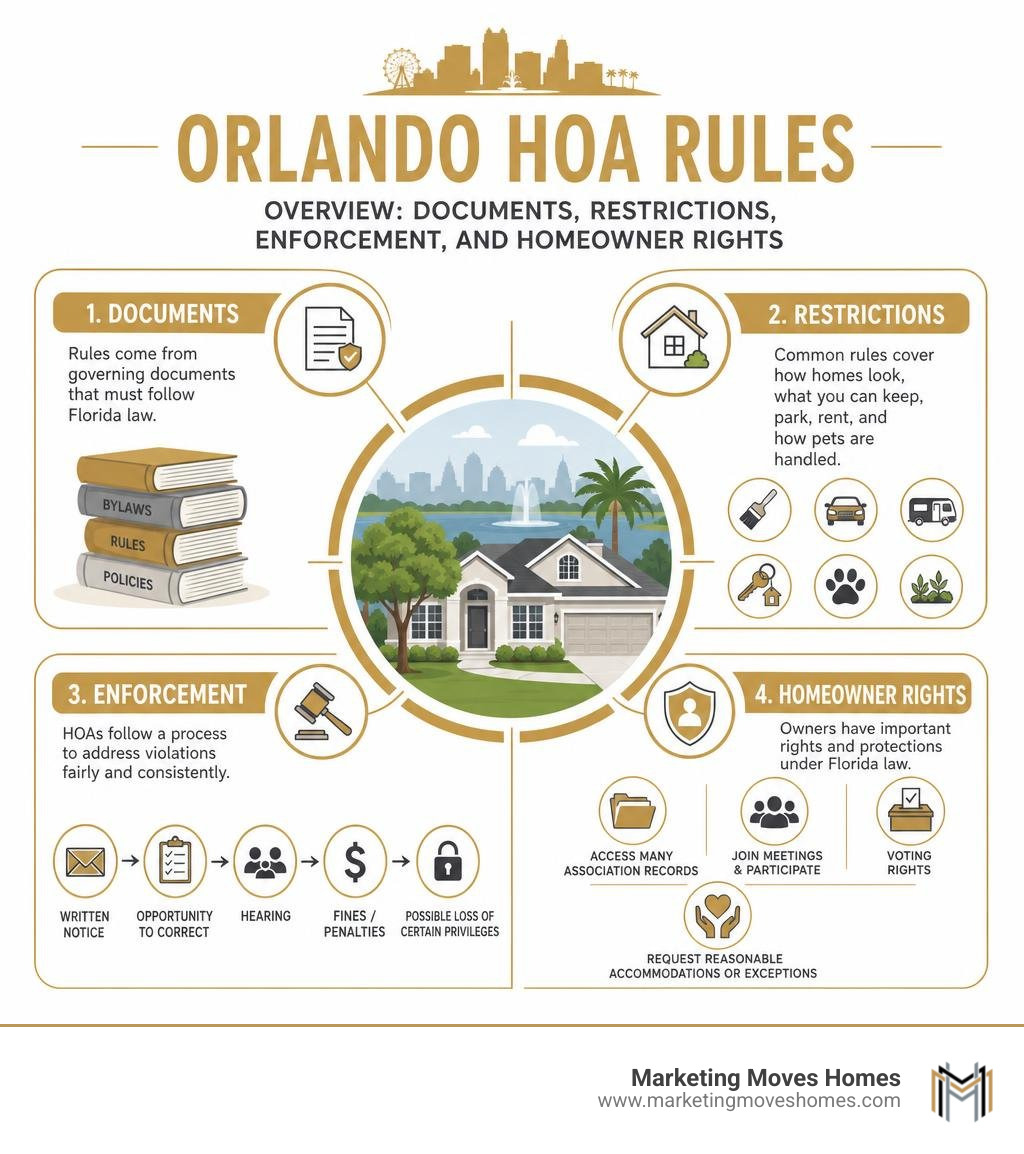
For a quick answer, most Orlando-area HOA rules cover:
- Home appearance: Exterior paint, roofs, fences, landscaping, lawn care, and approval for visible changes.
- Parking and vehicles: Street parking, commercial vehicles, boats, RVs, trailers, and sometimes golf carts.
- Rentals: Minimum lease terms, tenant applications, and limits on short-term rentals.
- Pets: Leash, waste, breed, size, and number-of-pet rules, subject to fair-housing protections for service and assistance animals.
- Enforcement: Written notices, an opportunity to correct the issue, hearings, fines, and possible suspension of certain common-area privileges.
- Owner rights: Access to many association records, meeting participation, voting rights, and the ability to request reasonable accommodations or exceptions.
In Lake Nona’s 32827 and 32832 ZIP codes, master-planned communities often have detailed covenants and architectural standards. Before making an offer, listing a property, or starting an exterior project, review the declaration, bylaws, rules, and architectural-review process. A rule that seems minor – such as where a trash bin sits or whether a driveway material is approved – can affect a purchase decision, sale timeline, or planned improvement.
I am Scott Brazdo MBA, a Central Florida REALTOR® with deep experience guiding buyers and sellers through the details that affect Orlando HOA rules, especially in Lake Nona communities. My local real estate work helps clients spot important restrictions early, so the next sections can break down the laws, common rules, and homeowner protections that matter most.
Quick look at Orlando HOA rules:
Key Florida Statutes Governing Orlando HOA Rules
When living in or buying a home within a Central Florida subdivision, many homeowners assume their local city or county government dictates neighborhood guidelines. However, mandatory homeowners’ associations (HOAs) and condominium associations (COAs) in Florida operate as state-chartered, private not-for-profit corporations under Florida Statute Chapter 617.
Because of this corporate structure, local municipal bodies—such as the City of Orlando or Orange County Code Enforcement—do not oversee private HOA disputes or dictate internal community rules. Instead, private associations derive their authority from recorded legal declarations and governing statutes established at the state level. Homeowners seeking guidance on state-level oversight can consult official resources like the City of Orlando Mandatory Association Resources.
Understanding this statutory foundation helps buyers and sellers understand how community covenants operate, how boards enforce rules, and where homeowner protections originate.

Statutory Framework: F.S. Chapter 720 and Chapter 718
The primary statutory pillar governing residential single-family and townhome subdivisions in Central Florida is Florida Statute Chapter 720, formally known as the Florida Homeowners’ Association Act. This legislation defines the legal powers, administrative rules, meeting protocols, voting procedures, and financial disclosures required of single-family community associations across the state.
For condominium communities, Florida Statute Chapter 718 (the Florida Condominium Act) regulates governance, common-element ownership, structural safety standards, and insurance mandates. While Chapter 718 governs condominiums and Chapter 720 governs single-family neighborhoods, both statutory frameworks mandate high standards of operational transparency and fiduciary duty for elected board directors.
To review an in-depth summary of state regulations and industry compliance standards, consult this comprehensive resource on HOA laws and regulations in Orlando, FL in 2026 – Steadily Insurance.
Florida Fair Housing Act and Consumer Collection Protections
In addition to property governance acts, Orlando HOAs are strictly bound by federal and state civil rights statutes. The Florida Fair Housing Act works alongside federal legislation to prohibit housing discrimination based on race, color, national origin, religion, sex, familial status, or disability. This law requires board directors and architectural committees to make reasonable accommodations for residents with disabilities, including granting exceptions to pet restrictions for verified service animals and emotional support animals.
Furthermore, when HOAs collect delinquent assessments or levy fines, their collection activities must adhere strictly to debt collection statutes, including the Florida Consumer Collection Practices Act (FCCPA) and the federal Fair Debt Collection Practices Act (FDCPA). Under state statutory protocols:
- Associations must issue a written statutory Notice of Late Assessment giving owners 30 days to respond before placing a property lien.
- Boards must send a secondary intent notice at least 45 days prior to formalizing an assessment lien against real estate titles.
- Associations are strictly prohibited from engaging in oppressive or misleading debt collection methods.
Common Restrictions in Central Florida HOA Communities

While state statutes set the legal framework, daily life within an Orlando neighborhood is largely shaped by the community’s Declaration of Covenants, Conditions, and Restrictions (CC&Rs), Bylaws, and Rules and Regulations. These deed restrictions run with the land, meaning every property purchaser automatically agrees to abide by them upon taking title.
In premier Orlando destinations—ranging from established enclaves in Doctor Phillips and Winter Park to master-planned luxury developments in Lake Nona and Viera—HOA guidelines protect neighborhood aesthetics, preserve shared infrastructure, and support long-term property values.
How Orlando HOA Rules Impact Property Appearance and Landscaping
Architectural uniformity is one of the most common reasons buyers choose deed-restricted neighborhoods. An Architectural Review Board (ARB) or Architectural Control Committee (ACC) oversees all visible property modifications to ensure home designs fit the neighborhood’s aesthetic standards.
Most Orlando HOAs enforce specific standards for exterior property care:
- Exterior Painting & Roof Replacement: Paint colors are restricted to pre-approved community palettes. Roofing materials must conform to architectural guidelines regarding material type, shingle weight, and color scheme. Sample exterior standards can be reviewed in the Orchid Terrace Homeowners’ Association, Inc. Community Standards.
- Lawn Maintenance & Turf Requirements: Communities often mandate specific warm-season turfgrasses, such as St. Augustine (Floratam), maintained to exact height thresholds (typically under 5 or 6 inches). Homeowners must maintain healthy, weed-free lawns, replace dead sod promptly, and ensure tree canopies clear sidewalks (8 feet) and roadways (up to 14 feet for emergency vehicles).
- Fences and Outdoor Structures: Homeowners must submit formal applications before installing fences, screened lanais, pergolas, or sheds. For example, waterfront properties may require transparent aluminum pickets rather than standard privacy fences to preserve water views, as outlined in the Avalon-Architectural-Guidelines_2025 v8.05.
- Driveway and Pressure Washing: Driveway expansions or paver replacements require prior committee approval. Homeowners are often given strict timelines (e.g., 30 days) to pressure clean roofs, sidewalks, and driveways when mildew or staining occurs.
Before starting any home modification project, always confirm your neighborhood’s specific application requirements. For instance, residents in Windermere communities can check local submittal procedures via the ARB – Lakes of Windermere portal.
Parking Restrictions, Vehicles, and Golf Carts
Parking regulations prevent street congestion, preserve emergency vehicle access, and maintain neat streetscapes. Standard parking restrictions across Orlando-area HOAs include:
- Overnight Street Parking Restrictions: Many neighborhoods prohibit overnight parking on residential streets. Vehicles must be parked within enclosed garages or on paved driveways.
- Commercial and Recreational Vehicles: Commercial vans, trailers, flatbeds, recreational vehicles (RVs), boats, and jet skis must be stored inside closed garages or taken to off-site storage facilities.
- Golf Carts and Low-Speed Vehicles (LSVs): Golf carts are popular in master-planned communities like Lake Nona and golf communities. However, standard golf carts are typically restricted to designated golf pathways unless retrofitted into street-legal Low-Speed Vehicles (LSVs) equipped with seatbelts, headlights, state registration, insurance, and proper board certification.
Because every HOA has its own governing documents, buyers should review the specific declaration, bylaws, parking rules, and architectural guidelines for the neighborhood they are considering instead of relying on examples from unrelated communities. Marketing Moves Homes can help buyers and sellers request the right HOA documents, spot practical restrictions early, and understand how those rules may affect a purchase, listing, or planned improvement.
Navigating Orlando HOA Rules for Leasing and Short-Term Rentals
Rental restrictions help protect community stability and manage owner-occupancy ratios. Investors looking at Central Florida residential real estate must verify an association’s lease policies before submitting an purchase offer:
- Minimum Lease Terms: Most standard single-family HOAs prohibit short-term, nightly, or weekly rentals. Minimum lease durations often range from three months to a year, and some communities also limit how many times a home can be leased within a year.
- Florida Statute § 720.306(1)(h): Under Florida law, amendments adopted after July 1, 2021, that restrict a parcel owner’s rental rights apply only to owners who purchase after the amendment takes effect or who consent to the change.
- Municipal Short-Term Rental Rules: Aside from HOA rules, local municipalities maintain distinct zoning laws regarding short-term rentals. Buyers considering rental-friendly communities should confirm both the association documents and local city or county rules before submitting an offer.
Pet Guidelines and Fair Housing Accommodations
Pet policies aim to maintain clean, safe, and peaceful living environments. Typical pet rules cover:
- Pet Quantity and Weight Caps: Restrictions often limit households to two domestic pets (dogs or cats) and may set weight caps (e.g., max 30 to 50 lbs per animal).
- Leash and Sanitation Requirements: Pets must remain on hand-held leashes in common areas, and owners must pick up pet waste immediately.
- Fair Housing Protections: Under the Florida Fair Housing Act, legitimate service animals and emotional support animals (ESAs) are legally classified as assistance animals rather than pets. Consequently, HOAs cannot enforce breed bans, weight limits, or pet fees against verified assistance animals when a homeowner submits a legitimate medical accommodation request.
HOA Enforcement, Fines, and Recent Legislative Reforms in Florida

When rule violations occur, Florida law strictly regulates how associations enforce compliance. HOA board directors cannot issue arbitrary penalties, impose immediate surprise fines, or confiscate property without following due process protocols.
Violation Penalties, Notice Periods, and Hearing Committees
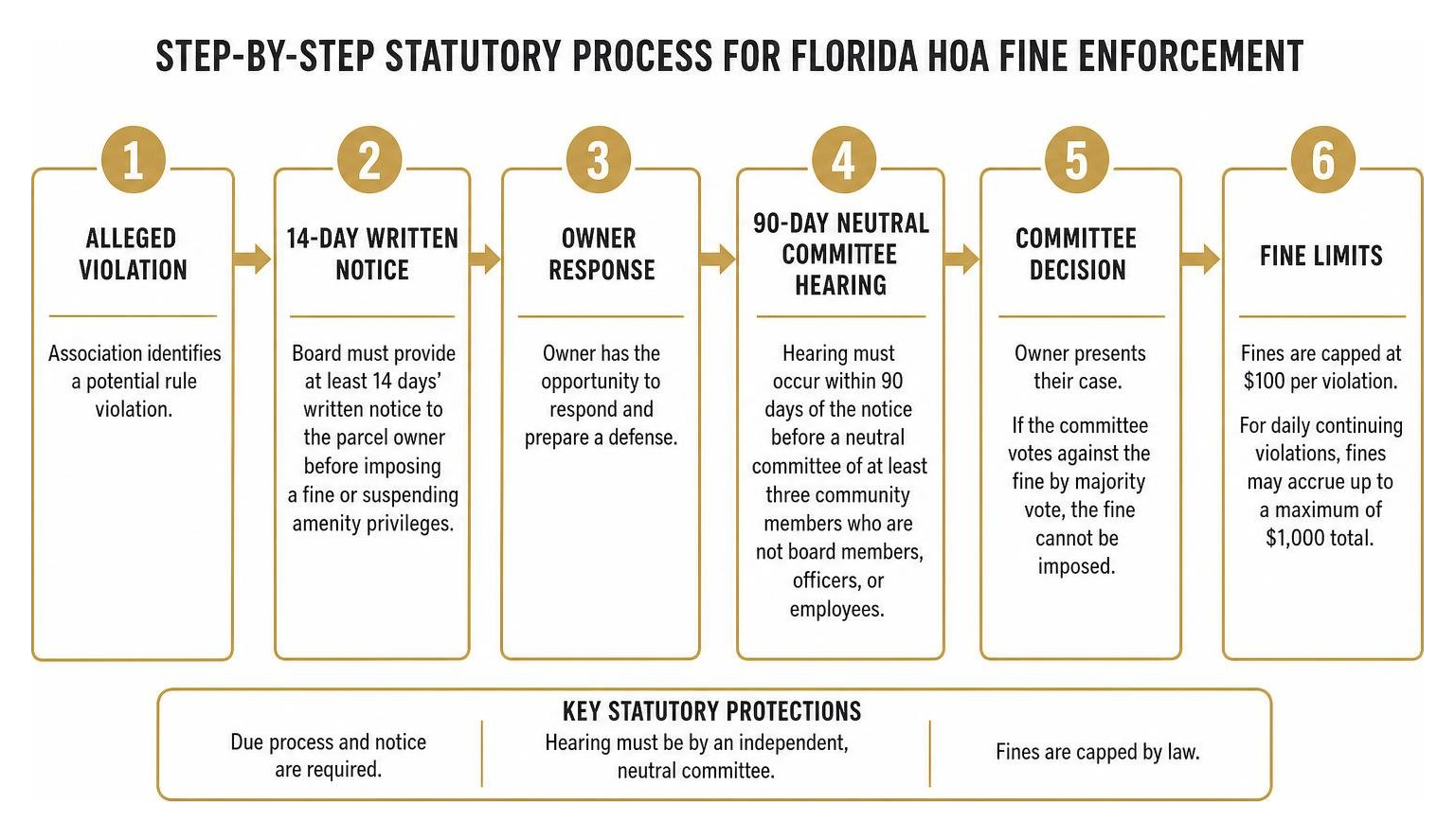
Florida Statute § 720.305 outlines clear statutory protections for homeowners facing alleged covenant violations:
- Statutory Fine Capping: Fines are legally capped at $100 per violation. If a violation continues on a daily basis, fines accumulate up to a statutory maximum limit of $1,000 total.
- 14-Day Written Notice Requirement: An association board cannot impose a fine or suspend amenity privileges without providing at least 14 days’ written notice to the parcel owner.
- 90-Day Neutral Committee Hearing: The owner has the right to present a defense at a formal hearing. The hearing must occur within 90 days of the notice and must be conducted by an independent committee of at least three neutral community members who are not board members, officers, or employees of the association.
- Committee Approval Mandate: If the neutral committee votes against the fine by majority vote, the fine cannot be imposed.
2024-2025 Transparency Laws and Board Training Requirements
Florida’s legislature introduced major statutory reforms aimed at improving HOA governance, financial transparency, and director accountability:
- Homeowners’ Association Bill of Rights (HB 919): Designed to protect parcel owners from conflicts of interest, kickback schemes, and improper meeting procedures, this law requires clear notice protocols and strict ethical standards for board members.
- Mandatory Website Portals: By January 1, 2025, HOAs with 100 or more parcels are legally required to post all official records—including declarations, bylaws, annual budgets, meeting minutes, and vendor contracts—on an accessible digital portal or website.
- Board Director Education: Board members must complete certified statutory training within 90 days of election. Directors in smaller communities complete 4 hours of approved instruction, while directors in larger master communities complete 8 hours.
- Mandatory Financial Record Retention: Associations must retain official financial records for a minimum of seven years. Additionally, communities with 100+ parcels must distribute annual budget updates and maintain strategic reserves for major capital projects.
- Structural Reserve Protections (SB 4-D / HB 1021): Enacted to safeguard structural integrity, recent legislation mandates milestone inspections every 10 years for multi-story residential buildings and strictly prevents associations from waiving required structural reserve funding.
How Homeowners Can Navigate Governance and Review Official Records
Whether buying, selling, or maintaining a home in an HOA community, clear communication and thorough document review are key to avoiding unexpected compliance issues.
When purchasing a home in an Orlando deed-restricted neighborhood, prospective buyers should review key governing documents prior to closing:
- Declaration of Covenants, Conditions, and Restrictions (CC&Rs): The primary legal document detailing property restrictions, maintenance duties, and community rules.
- Bylaws and Financial Budgets: Documents outlining board election procedures, meeting frequency, annual dues, reserve fund strength, and active special assessments.
- Architectural Guidelines: Specific design standards for paint colors, roofs, fences, and landscaping modifications.
If an HOA board or seller does not immediately provide complete governing documents, ask for the community’s recorded declaration, bylaws, rules, architectural guidelines, budgets, meeting records, and disclosure documents before moving forward. Marketing Moves Homes can help buyers and sellers review the right paperwork and understand how the rules may affect a purchase, listing, or planned improvement.
If you are planning to purchase or list a home in Central Florida, our team can help you navigate local HOA disclosures, evaluate association financial health, and position your property for a smooth sale. Explore available homes and community disclosures through our Buy a Home portal.
Frequently Asked Questions About Orlando HOA Rules
What are the primary state laws governing HOAs in Orlando?
Residential HOAs in Orlando are primarily governed by Florida Statute Chapter 720 (The Florida Homeowners’ Association Act) and Chapter 617 (Florida Not for Profit Corporation Act). Condominium communities are governed under Florida Statute Chapter 718 (The Florida Condominium Act). Additionally, housing practices must comply with the Florida Fair Housing Act and state consumer debt collection acts.
How much can an HOA fine a homeowner in Florida?
Under Florida Statute § 720.305, individual fines are legally capped at $100 per single violation. For ongoing violations, daily fines can accumulate up to a statutory maximum total of $1,000. Associations must provide 14 days’ written notice and hold a hearing before an independent committee before any fine becomes final.
Where can Orlando homeowners access their official HOA rules and records?
Homeowners can request governing documents directly from their HOA board or property management company. Additionally, official recorded declarations and amendments are public records accessible through the Orange County Comptroller Official Records Department. Under state law, communities with 100 or more parcels must also make these records available on an accessible member portal.
Conclusion
Understanding Orlando HOA rules is essential for protecting your property investment, maintaining your home’s value, and enjoying a seamless community lifestyle. From architectural guidelines and landscape standards to parking protocols, leasing terms, and statutory enforcement rights, deed restrictions shape the daily real estate experience across Central Florida.
At Marketing Moves Homes, we specialize in helping buyers and sellers navigate deed-restricted communities throughout Greater Orlando. Our deep focus on Lake Nona’s 32827 and 32832 ZIP codes—alongside premier Central Florida markets like Windermere, Doctor Phillips, Winter Park, and Viera—positions our team as your local market authority.
When selling your property, our advanced digital listing strategies showcase your home’s unique features, highlight community amenities, and attract qualified buyers quickly. When buying, we provide expert guidance through HOA document reviews, reserve evaluations, and neighborhood restriction checks so you can move forward with total confidence.
Whether you are preparing to list your property or searching for your next home, partner with local real estate experts who understand the nuances of Central Florida HOA governance. Contact us today to schedule your custom home market evaluation or explore our dedicated Orlando Real Estate Services.