Step-by-Step Guide to Estimate Home Value Accurately
Step-by-Step Guide to Estimate Home Value Accurately
Proven Valuation Methods: The Best Way to Determine Home Value
Determining what a property is truly worth requires looking at hard market evidence. While every homeowner hopes their property commands a record-setting price, fair market value is ultimately defined by what a willing, qualified buyer will pay in today’s open market.
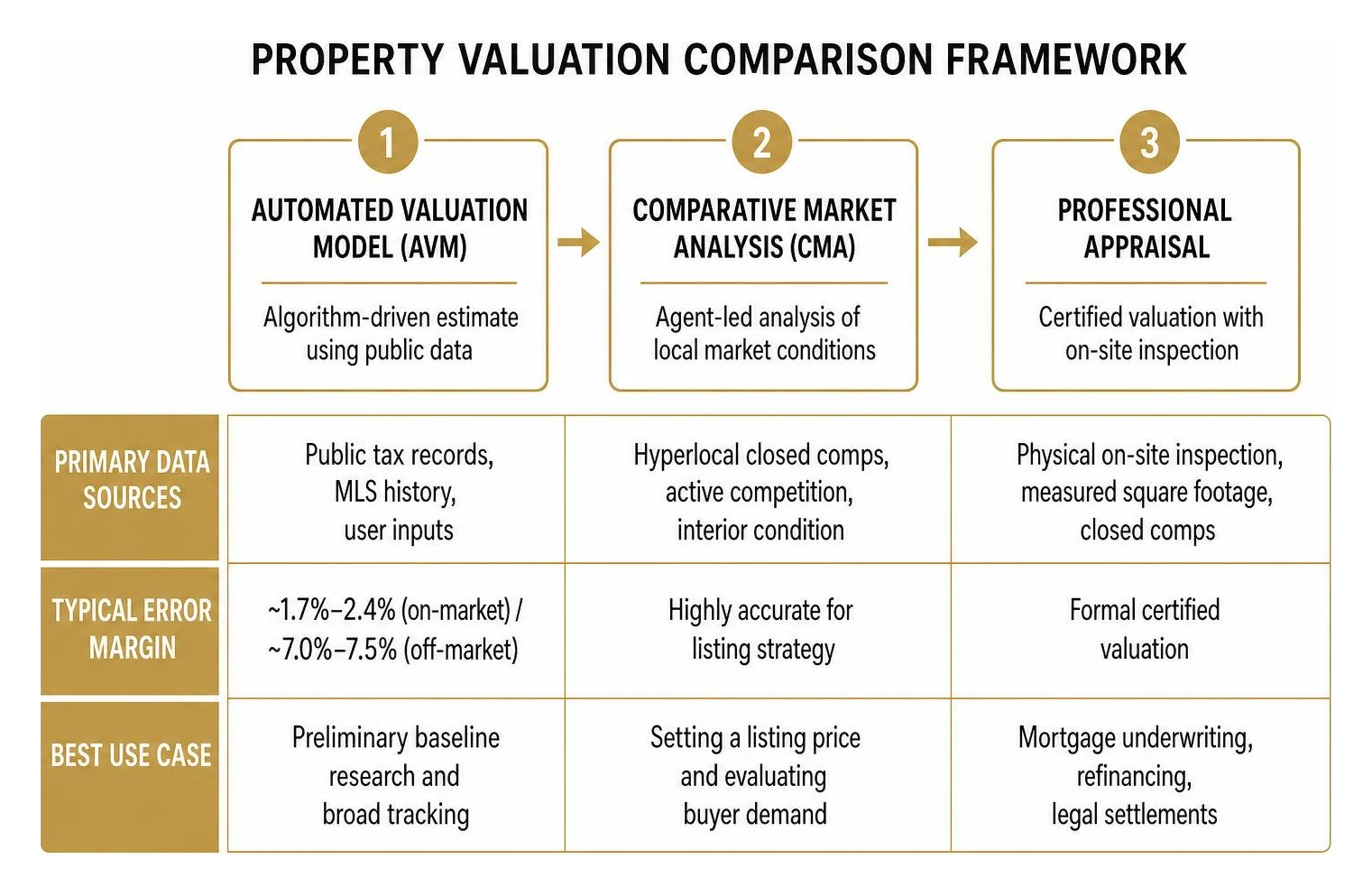
To find that number, real estate professionals evaluate three primary valuation methods: automated digital algorithms, agent-led market studies, and certified appraisals.
| Valuation Method | Primary Data Sources | Typical Error Margin | Best Use Case |
|---|---|---|---|
| Automated Valuation Model (AVM) | Public tax records, MLS history, user inputs | ~1.7%–2.4% (on-market) / ~7.0%–7.5% (off-market) | Preliminary baseline research and broad tracking |
| Comparative Market Analysis (CMA) | Hyperlocal closed comps, active competition, interior condition | Highly accurate for listing strategy | Setting a listing price and evaluating buyer demand |
| Professional Appraisal | Physical on-site inspection, measured square footage, closed comps | Formal certified valuation | Mortgage underwriting, refinancing, legal settlements |
Automated Valuation Models and the Best Way to Determine Home Value Baseline
Automated Valuation Models (AVMs) run on complex neural networks that aggregate data from county tax assessor records, historical deed transfers, and regional MLS feeds. They provide an instant snapshot of property value without requiring an on-site visit.
However, automated online estimates can be inaccurate due to missing local condition, upgrades, neighborhood nuance, and current Orlando market dynamics. Nationwide data reveals that while automated tools achieve a median error rate of roughly 1.7% to 2.4% on active listings, that margin expands significantly to 7.01% to 7.49% for off-market properties.
On an $850,000 off-market home in Lake Nona, a 7% error rate represents a discrepancy of nearly $60,000. Algorithms cannot detect fresh interior paint, updated quartz countertops, or the subtle difference between a tranquil conservation view and a lot backing up to road noise.
Why a CMA is the Best Way to Determine Home Value Before Listing
A Comparative Market Analysis (CMA) bridges the gap between raw statistical data and real-world market appeal. Prepared by a local real estate professional, a CMA examines closed transactions from the past 30 to 90 days involving properties with similar layouts, square footage, and build years.
Unlike a computer algorithm, a local Realtor walks the home, evaluates custom improvements, accounts for community amenities, and reviews current competing inventory. When preparing to sell, reviewing a detailed Lake Nona market analysis ensures that your pricing strategy aligns with buyer activity in your specific neighborhood.
Professional Appraisals for Lending and Legal Transactions
A professional appraisal is an unbiased, formal assessment conducted by a state-licensed residential appraiser. Lenders require appraisals before issuing a mortgage to ensure the property provides adequate collateral for the loan amount.
During a full appraisal, the appraiser measures the exterior footprint, verifies legal bedroom and bathroom counts, reviews building permits, inspects structural integrity, and photographs key living areas. Appraisals typically cost between $300 and $500 for standard single-family homes, with complex or luxury estates running higher. Appraisals serve as the legal standard for mortgage underwriting, estate settlements, and property tax disputes.
Step-by-Step Guide to Estimating Your Property Value
Arriving at an accurate valuation requires a structured evaluation process. By following these steps, you can establish a realistic pricing benchmark before going to market.
Step 1: Collect Accurate Property Specifications and Update Public Data
Begin by verifying your home’s official public footprint. Automated algorithms and comparative evaluations rely on municipal property records, which can lag behind recent physical improvements.
- Check your total heated and cooled square footage against county property appraiser records.
- Confirm that permitted room additions, finished spaces, or bathroom remodels are accurately documented.
- Document the age of major mechanical systems, including the roof, HVAC units, and water heater.
Step 2: Source Hyperlocal Closed Sales Comps
True market value is demonstrated by what buyers have actually paid, not what neighboring sellers are asking. When sourcing comparable sales (“comps”):
- Focus on geographic proximity: Pull properties within the same subdivision or within a 0.5-mile radius. In master-planned developments, crossing major thoroughfares can place a home into an entirely different micro-market.
- Prioritize recent sales: Limit your primary search to homes closed within the last 30 to 90 days. In shifting markets, sales older than six months reflect outdated interest rate and inventory environments.
- Match core specifications: Select 3 to 5 sold homes that match your property within ±20% of total square footage, similar lot sizes, and comparable architectural styles. Reviewing a practical checklist for Lake Nona real estate helps identify neighborhood-specific variables that impact comp selection.
Step 3: Apply Quantitative Adjustments for Features and Condition
No two properties are identical. Once you have calculated the baseline average price per square foot from your selected comps, apply realistic line-item adjustments:
- Outdoor Living & Pools: In Central Florida, a private screened pool and paved lanai can add substantial value compared to a home with a basic grass yard.
- Lot Premiums: Cul-de-sac placement, conservation frontage, and waterfront lots command clear price premiums over interior lots or properties bordering commercial developments.
- Interior Upgrades: High-grade kitchen cabinetry, modern flooring, and spa-inspired primary bathrooms elevate a home toward the top of its competitive price band.
- Deferred Maintenance: Older roofs, aging mechanical systems, or worn flooring require downward valuation adjustments to account for buyer repair allowances.
Key Factors That Drive Central Florida Real Estate Values
Valuation extends beyond four walls and a roof. In the greater Orlando area, localized lifestyle drivers and macro market conditions play a massive role in shaping buyer demand.
Neighborhood Dynamics, School Districts, and Community Amenities
Hyperlocal location remains the strongest driver of residential value. In southeast Orlando, ZIP codes 32827 and 32832 attract strong buyer interest due to proximity to the Lake Nona Medical City, the USTA National Campus, autonomous transit corridors, and top-rated public schools.
HOA-maintained standards, community resort pools, fitness centers, and miles of integrated walking trails establish high baseline property values across neighborhoods like Laureate Park, VillageWalk, and Lake Nona Golf & Country Club. Properties located within walking distance of town centers or community schools consistently command higher demand.
Supply, Demand, and Regional Market Conditions
Broader economic factors directly influence what buyers can offer on a home. As mortgage rates adjust, purchasing power expands or contracts, impacting overall transaction velocity.
Staying informed on Lake Nona market trends and interest rate shifts provides clarity on buyer sentiment. Tracking local market balance also means analyzing Orlando inventory levels to determine whether available listings represent a seller-favorable environment or a more balanced market.
Long-Term Appreciation and Strategic Property Upgrades
In healthy, sustainable housing markets, residential properties historically appreciate at an average rate of 3% to 4% annually. Strategic property maintenance and smart functional updates preserve that equity over time.
Homeowners planning ahead often evaluate how to estimate house value in 5 years by analyzing historical area appreciation alongside planned regional infrastructure. When upgrading for resale, prioritize improvements that offer strong returns—such as refreshed kitchens, modern exterior garage doors, and low-maintenance landscaping—over hyper-personalized luxury additions.
Frequently Asked Questions About Home Valuation
How accurate are automated online valuation estimators for off-market homes?
Automated valuation algorithms carry a median error rate of roughly 7% to 7.5% on off-market homes. Because the algorithm relies strictly on historical public records without seeing interior renovations, layout flow, or property wear, off-market estimates should only serve as an initial starting point rather than a definitive price tag.
What is the difference between assessed value and fair market value?
Assessed value is calculated annually by the county property appraiser strictly for municipal property tax calculations. In Florida, assessed values frequently lag behind real-time market value by 20% or more due to statutory assessment caps and historical valuation formulas. Fair market value reflects the actual price a buyer is willing to pay under current market conditions.
When is a professional home appraisal legally required?
A formal appraisal from a state-certified appraiser is legally required whenever a buyer uses a conventional, FHA, or VA mortgage to purchase a home. Appraisals are also mandated during cash-out refinances, court-ordered estate settlements, divorce proceedings, and formal property tax assessment appeals.
Conclusion
Accurately determining your home’s value protects your equity and positions your property for a successful, profitable sale. While automated digital estimates offer a convenient snapshot, they cannot replace the precision of a professional Comparative Market Analysis backed by on-the-ground Central Florida market insight.
At Marketing Moves Homes, we pair comprehensive neighborhood valuation data with advanced digital and traditional marketing—including architectural photography, cinematic video tours, targeted digital campaigns, and direct mail—to showcase your property’s unique value and sell homes faster than local averages.
Whether you are preparing to list your current residence or exploring Central Florida properties to buy a home, connect with our local team today for an accurate, no-obligation valuation and pricing consultation tailored to your neighborhood.