
Seller Net Sheet Calculator: Estimating Real Estate Closing Costs Easily
Seller Net Sheet Calculator: Estimating Real Estate Closing Costs Easily
Calculate Your True Home-Sale Proceeds Before You List
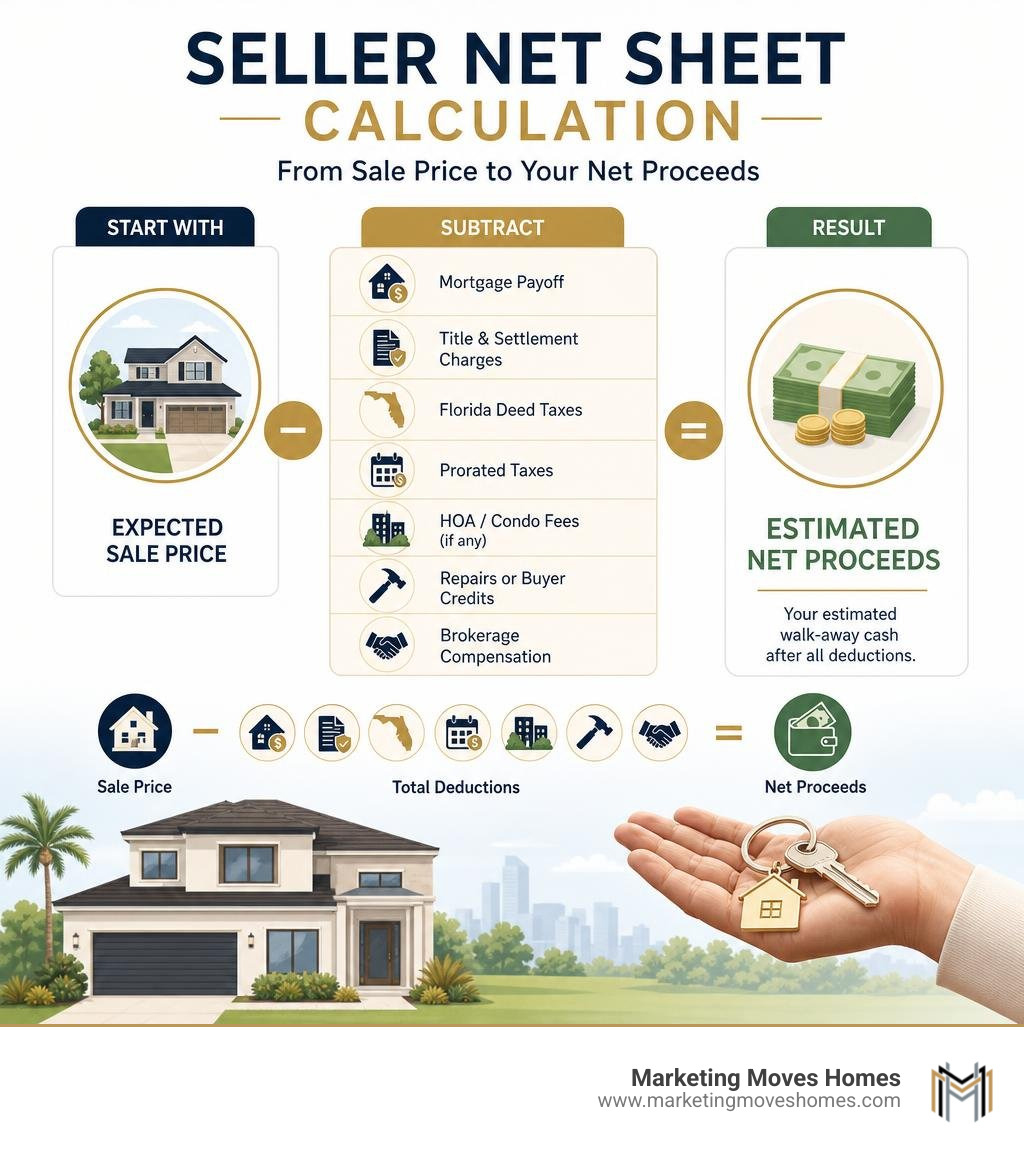
A seller net sheet calculator estimates the cash you may receive after selling your home by starting with the sale price and subtracting your mortgage payoff, seller closing costs, taxes, credits, and other transaction-related expenses.
| Start with | Subtract | Result |
|---|---|---|
| Expected sale price | Mortgage payoff, Florida deed taxes, title and settlement charges, prorated taxes, HOA-related costs, repairs or buyer credits, and negotiated brokerage compensation | Estimated net walk-away cash |
For Lake Nona homeowners in 32827 and 32832, this is more useful than focusing on the list price or even gross equity alone. Gross equity is the sale price less the mortgage balance. Net proceeds are what remain after the full set of selling costs is accounted for. That is the number that helps you plan your next purchase, move, or financial goal with fewer surprises.
A calculator is a planning tool, not a final settlement document. Florida customs, the exact closing date, lender payoff interest, property-tax prorations, HOA or condo requirements, and offer terms can all change the final amount. A strong net sheet gives you a clear starting point before listing and a better way to judge offers when they arrive.
I am Scott Brazdo, MBA, a Central Florida REALTOR and Lake Nona listing expert with more than 30 years of marketing experience and deep local knowledge of residential home sales. I use a seller net sheet calculator as part of clear, practical seller guidance, helping homeowners understand their likely proceeds before making major listing and moving decisions.
Understanding Gross Equity vs Net Walk-Away Cash
When evaluating the financial wisdom of listing your property, it is easy to confuse gross home equity with true net proceeds. Gross equity is simply the raw math of taking your estimated top-line home valuation and subtracting your primary mortgage balance. For example, if your home in Lake Nona’s Laureate Park is valued at $650,000 and your remaining mortgage balance is $350,000, your gross equity is $300,000.
However, gross equity is a preliminary metric. You cannot deposit gross equity into your bank account on closing day. What you actually walk away with is your net proceeds—the actual cash wired to your bank account after subtracting settlement fees, statutory deed transfer taxes, municipal lien searches, title services, tax prorations, and professional service fees. Across the United States and specifically in Florida, transaction costs, pre-sale prep, and closing expenses typically account for 8% to 10% of the total purchase price. In addition, seller closing costs alone (excluding brokerage compensation) routinely run between 1% and 3% of the sales price.
To learn more about how settlement flows work locally, check out our detailed guide on navigating your lake nona real estate closing like a pro.
Why Every Home Seller Needs a Seller Net Sheet Calculator Before Listing
Relying solely on headline listing prices or generic automated online estimate sites can lead to costly miscalculations. Automated online estimate tools frequently miss critical local details—such as high-end kitchen upgrades, premium lot positioning, custom pool additions, or hyper-local neighborhood nuances within Lake Nona’s 32827 and 32832 ZIP codes.
Using a specialized seller net sheet calculator before setting your list price allows us to test multiple financial scenarios. Whether we are assessing a cash offer with quick closing terms or a conventional loan offer requesting seller credits, a net sheet reveals the bottom line. Running these numbers during our initial pricing consultation ensures you make listing decisions anchored in financial reality, protecting you from unexpected cash shortages when transitioning to your next home.
Key Closing Cost Line Items That Reduce Your Net Proceeds
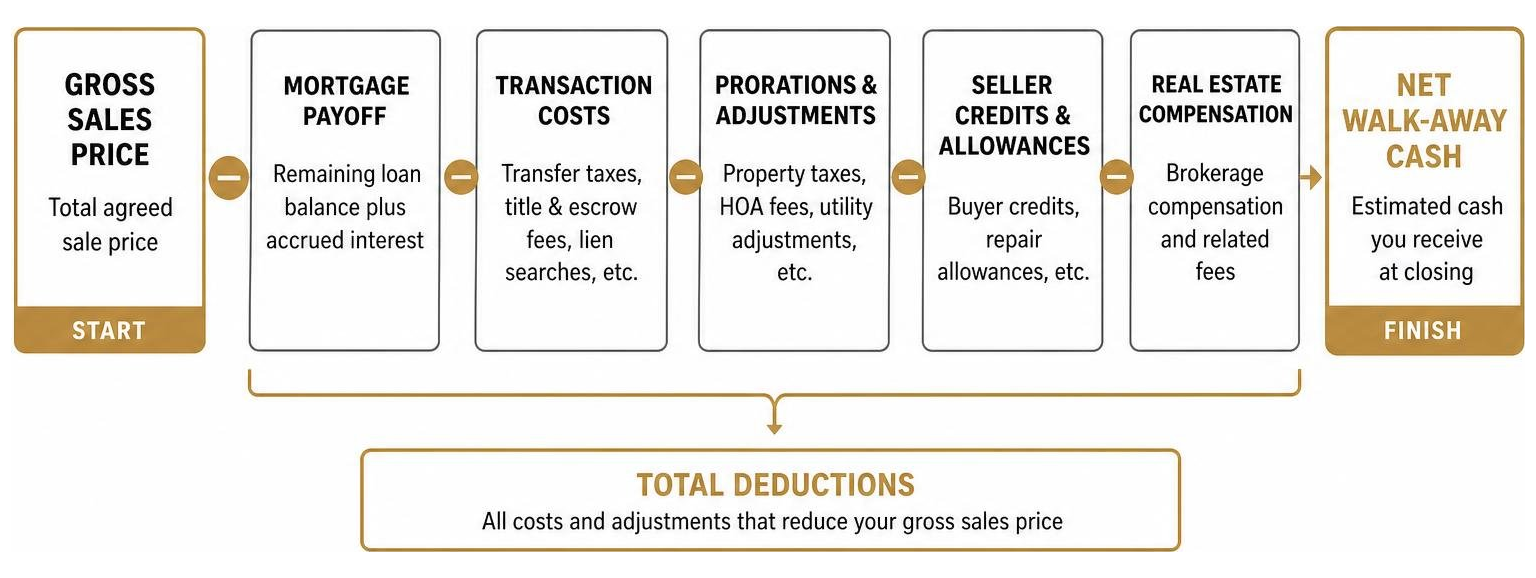
A comprehensive net calculation breaks down transaction costs line by line so you are never caught off guard at the settlement table. The primary categories that reduce your gross price include:
- Mortgage Payoff Balances: Your remaining principal balance plus daily per-diem interest accrued up to the day funds are disbursed.
- State Transfer Taxes: Mandatory documentary stamps on the deed transferred to the buyer.
- Title and Escrow Fees: Closing agent charges, settlement fees, municipal lien search fees, and owner’s title insurance policies.
- Prorated Property Taxes: Florida ad valorem property taxes owed for the calendar days you owned the home during the sale year.
- HOA & Community Fees: Estoppel certificate preparation fees, capital contribution transfer charges, and prorated monthly or quarterly dues.
- Seller Credits & Repair Allowances: Negotiated credits provided to the buyer for closing cost assistance or home repairs.
- Professional Real Estate Compensation: Agreed brokerage compensation for marketing, pricing strategy, client representation, and negotiation services.
How a Seller Net Sheet Calculator Estimates Your Lake Nona Walk-Away Cash
Calculating estimated net proceeds in Central Florida requires an understanding of specific Florida Statutes, local closing customs, and municipal tax rules. A general national calculator often fails because local rules vary across county lines. In Orange County, Florida, specific legal frameworks govern how deed stamps, title policies, and tax prorations are allocated. Sellers who use specialized Florida tools, such as the Florida Seller Net Sheet Calculator, gain a much clearer picture of how state-specific line items impact their final check.
Florida Transfer Taxes and Title Insurance Conventions
In Florida, transferring real estate ownership incurs statutory taxes and closing expenses defined by state law and regional real estate contract standards:
- Documentary Stamp Tax on Deeds (F.S. § 201.02): In Orange County and throughout most of Central Florida, the state levies a documentary stamp tax of $0.70 per $100 of total purchase price (or fraction thereof). For instance, on a $500,000 home sale in Lake Nona, the seller customarily pays $3,500 in deed documentary stamps.
- Owner’s Title Insurance Policy Conventions: Title insurance rates are regulated by the Florida Office of Insurance Regulation (OIR) under F.S. § 627.7825 using a standardized tiered premium scale. Who pays for the owner’s title policy depends heavily on local county custom and contract terms. In Orange County, standard contract practice dictates that the seller selects the closing agent and pays for the owner’s title insurance policy. Conversely, in neighboring counties like Broward or Miami-Dade, the buyer customarily pays for title insurance. Understanding these regional boundaries prevents multi-thousand-dollar miscalculations.
Property Tax Prorations and HOA Estoppel Fees
Property taxes in Florida create another unique calculation factor on net sheets because ad valorem property taxes are paid in arrears. November tax bills cover the entire preceding calendar year. Under Florida Statute § 197.0734, property taxes must be prorated at closing:
- If you close on your home on August 31st, you have occupied the home for 243 days of that tax year without paying property taxes yet.
- At the closing table, we calculate your daily tax rate based on the prior year’s tax bill (or current millage rates) and issue a prorated credit to the buyer for those 243 days.
- The buyer will then pay the full property tax bill when it arrives in November.
Closing later in the calendar year means a larger prorated tax credit to the buyer, which reduces your walk-away cash on closing day (even though you effectively held onto those property tax funds throughout the year).
Additionally, many properties in Lake Nona feature master-planned structures, community development districts (CDDs), and homeowners associations. Obtaining an official HOA estoppel certificate—which verifies that your dues are current and outlines any transfer fees—is legally required prior to closing. Estoppel preparation fees are statutory line items that appear on your seller net sheet.
7 Solutions for Accurate Net Sheet Calculations
To eliminate surprises and achieve total financial transparency, home sellers should follow these seven practical strategies when generating and evaluating their seller net sheet calculator results.

1. Request an Official Lender Payoff Quote
One of the most common mistakes sellers make when running net calculations is grabbing the principal balance directly from their latest monthly mortgage statement. Your online balance statement shows the remaining principal balance, but it does not reflect the complete payoff amount needed to release the mortgage lien.
Mortgage interest accrues daily in arrears. When your closing agent settles your mortgage loan, they must wire funds covering accrued per-diem interest from the first day of the month through the date the lender receives the payoff funds, plus statement processing and lien release recording fees. Payoff demands are usually 0.5% to 1.5% higher than monthly statement balances.
To ensure complete accuracy on your net sheet, request an official 30-day payoff demand letter directly from your loan servicer rather than using your monthly statement principal balance.
2. Factor in Local Central Florida Closing Costs
Closing cost details vary by municipality and settlement service provider. Beyond basic deed transfer taxes and title insurance policies, a precise Central Florida seller net sheet must account for localized administrative and closing fees, including:
- Municipal Lien Search Fees: Title companies perform searches to verify there are no unrecorded municipal utility liens, code enforcement violations, or open permits on your property.
- Closing Agent / Settlement Fees: Escrow management fees charged by title companies and real estate settlement attorneys typically range from $300 to $500 for seller-side document preparation.
- County Recording Fees: Official charges levied by the Orange County Comptroller to record mortgage satisfaction documents in public records.
Factoring in these administrative charges guarantees that your estimated walk-away proceeds match your final settlement figures.
3. Account for Home Staging and Property Preparation Costs
Pre-sale property preparation directly impacts your final sale price and eventual net proceeds. Expert presentation elevates buyer appeal, reduces days on market, and commands stronger offers.
According to research from the National Association of REALTORS® Profile of Home Staging:
- Buyer Visualization: 83% of buyers’ agents report that home staging makes it significantly easier for buyers to visualize a property as their future home.
- Higher Offer Values: 22% of sellers’ agents note that buyers offered a 1% to 5% dollar value increase for staged homes compared to similar unstaged properties, while 17% reported an offer value increase between 6% and 10%.
- High-Impact Recommendations: 95% of real estate professionals recommend decluttering before listing, and 89% recommend a full professional house deep clean to maximize buyer appeal.
Factoring these strategic preparation expenses into your net calculations helps ensure your upfront investments translate into higher purchase offers and stronger walk-away cash.
To learn how strategic presentation elevates market performance, explore our complete guide on the home staging process from first consultation to final sale.
4. Separate Capital Gains Taxes from Your Net Sheet
A net sheet calculator estimates your immediate cash flow at the closing table—it does not calculate your personal federal income tax liability. Homeowners sometimes mistakenly expect capital gains taxes to be deducted automatically at settlement, but title agents do not withhold income taxes at closing (with the exception of foreign sellers subject to FIRPTA withholding rules).
Under IRS Section 121, primary homeowners can exclude significant capital gains when selling their main home:
- Single Filers: Exclude up to $250,000 in capital gains.
- Married Couples Filing Jointly: Exclude up to $500,000 in capital gains.
To qualify for this exclusion, you must have owned and lived in the home as your primary residence for at least two out of the five years preceding the sale date. Capital improvements—such as adding a pool, renovating a kitchen, or installing a new HVAC system—can be added to your original purchase cost basis, further reducing potential tax liabilities. Because tax rules depend on individual financial situations, consult a certified public accountant (CPA) regarding capital gains.
5. Compare Multiple Buyer Offers Side-by-Side
When offers arrive, focusing solely on the purchase price can lead to poor financial choices. An offer with a higher gross price that demands significant seller concessions, rate buy-downs, or extensive repair credits may net you less cash than a clean, lower-priced cash offer.
For example, when reviewing cash offers, it is important to review the full purchase contract, seller net sheet, proof of funds, financing contingencies, closing cost allocations, tax prorations, inspection language, and representation terms. A cash offer might present a slightly lower gross purchase price, but if it waives buyer concessions and closes quickly, your net walk-away cash could be higher due to reduced per-diem mortgage interest and property tax prorations.
Here is how three competing buyer offers on a Lake Nona property might look on a comparative net sheet:
| Offer Component | Offer A (High Price + Concessions) | Offer B (Moderate Price + Clean Terms) | Offer C (Cash Offer + Quick Close) |
|---|---|---|---|
| Gross Purchase Price | $520,000 | $505,000 | $495,000 |
| Mortgage Payoff Balance | $300,000 | $300,000 | $300,000 |
| Seller Concessions / Credits | $15,000 | $0 | $0 |
| FL Deed Stamps ($0.70/$100) | $3,640 | $3,535 | $3,465 |
| Title & Settlement Charges | $3,100 | $3,025 | $2,975 |
| Prorated Taxes & HOA Dues | $2,800 | $2,800 | $1,200 (Earlier Close) |
| Est. Professional Compensation | Standard negotiated | Standard negotiated | Standard negotiated |
| Estimated Net Proceeds | ~$165,460 | ~$165,340 | ~$157,660 |
Running a comparative net sheet shows that Offer A and Offer B deliver nearly identical net proceeds, even though Offer A’s gross purchase price is $15,000 higher. Having this side-by-side view allows you to evaluate terms with complete clarity.
6. Common Calculation Errors in an Online Seller Net Sheet Calculator
While an online seller net sheet calculator provides a great starting framework, automated tools have inherent limitations. Common estimation gaps include:
- Ignoring Specific County Customs: Generic calculators often apply uniform title policy splits across all 67 Florida counties, miscalculating whether the buyer or seller customarily pays for title insurance.
- Underestimating HOA & CDD Estoppel Charges: Lake Nona features master communities with dedicated association management companies that charge administrative transfer fees not tracked by national tools.
- Incorrect Tax Prorations: Failing to account for whether local property taxes are billed in arrears or in advance can throw tax prorations off by thousands of dollars.
- Per-Diem Interest Calculations: Omitting daily accrued mortgage interest leads to lower payoff estimations than what the lender requires.
For additional statutory guidelines and planning tools, state resources like the Florida Retirement System’s Seller Net Proceeds Calculator offer additional perspective on calculating home equity. However, keep in mind that online calculators are planning tools. Final legal figures are formalized on the Closing Disclosure (CD) prepared by your settlement agent prior to closing.
7. Project Long-Term Equity Trends Before Selling
Timing your sale is another key factor in maximizing net proceeds. Homeowners evaluating whether to list immediately or hold for additional equity growth should evaluate local appreciation rates, ongoing principal reduction on their mortgage, and shifting market conditions.
Every month you retain your mortgage, your monthly principal payment increases your gross equity cushion. Combining steady loan payoff with long-term real estate appreciation strengthens your net proceeds when you choose to sell.
To explore methods for projecting home values over time, read our detailed article on how to estimate house value in 5 years without a crystal ball.
Frequently Asked Questions About Net Sheet Calculations
What is the difference between a seller net sheet and a Closing Disclosure?
A seller net sheet is an preliminary planning estimate generated by your real estate professional or an online calculator during listing consultations and offer evaluations to forecast walk-away proceeds. A Closing Disclosure (CD) is an official legal settlement document issued by your title company or closing attorney at least three business days prior to closing. The Closing Disclosure outlines every finalized financial line item, credit, prorated tax, and exact wire transfer amount required for settlement.
Do I pay capital gains tax directly at the closing table?
No, capital gains taxes are not withheld or collected at the closing table by title agents for domestic home sales. Capital gains tax liabilities are reported and handled separately when filing your federal tax returns with the IRS. Under IRS Section 121, primary homeowners can exclude up to $250,000 (single) or $500,000 (married filing jointly) in capital gains if they owned and lived in the home as their primary residence for at least two of the past five years. An exception applies to foreign property owners subject to federal FIRPTA tax withholding rules.
Why is my mortgage payoff higher than my monthly statement balance?
Your monthly mortgage statement displays your remaining principal balance as of the billing cycle date. Your actual payoff amount includes that principal balance plus accrued per-diem interest calculated from the first day of the current month through the exact date your lender receives the wired funds. Payoff demands also include administrative fees for processing loan satisfactions and recording release deeds in county public records.
Conclusion
Calculating your true net proceeds is one of the most critical steps in planning a successful home sale. By looking past headline listing prices and focusing on your net walk-away cash, you can navigate negotiations with confidence, evaluate competing buyer offers effectively, and protect your hard-earned equity.
At Marketing Moves Homes, we specialize in helping Lake Nona and Central Florida homeowners navigate complex real estate transactions. Using high-impact marketing—including professional photography, cinematic video tours, targeted digital campaigns, and direct mail—we help our clients sell quickly and net top dollar for their homes.
When you are ready to explore what your home is worth in today’s market, Ready to list your home in Lake Nona? Contact Marketing Moves Homes today for a personalized pricing consultation and detailed seller net sheet customized to your property.