
Find the True Appraised Value of Your House Easily
Find the True Appraised Value of Your House Easily
How to Find the Appraised Value of Your House
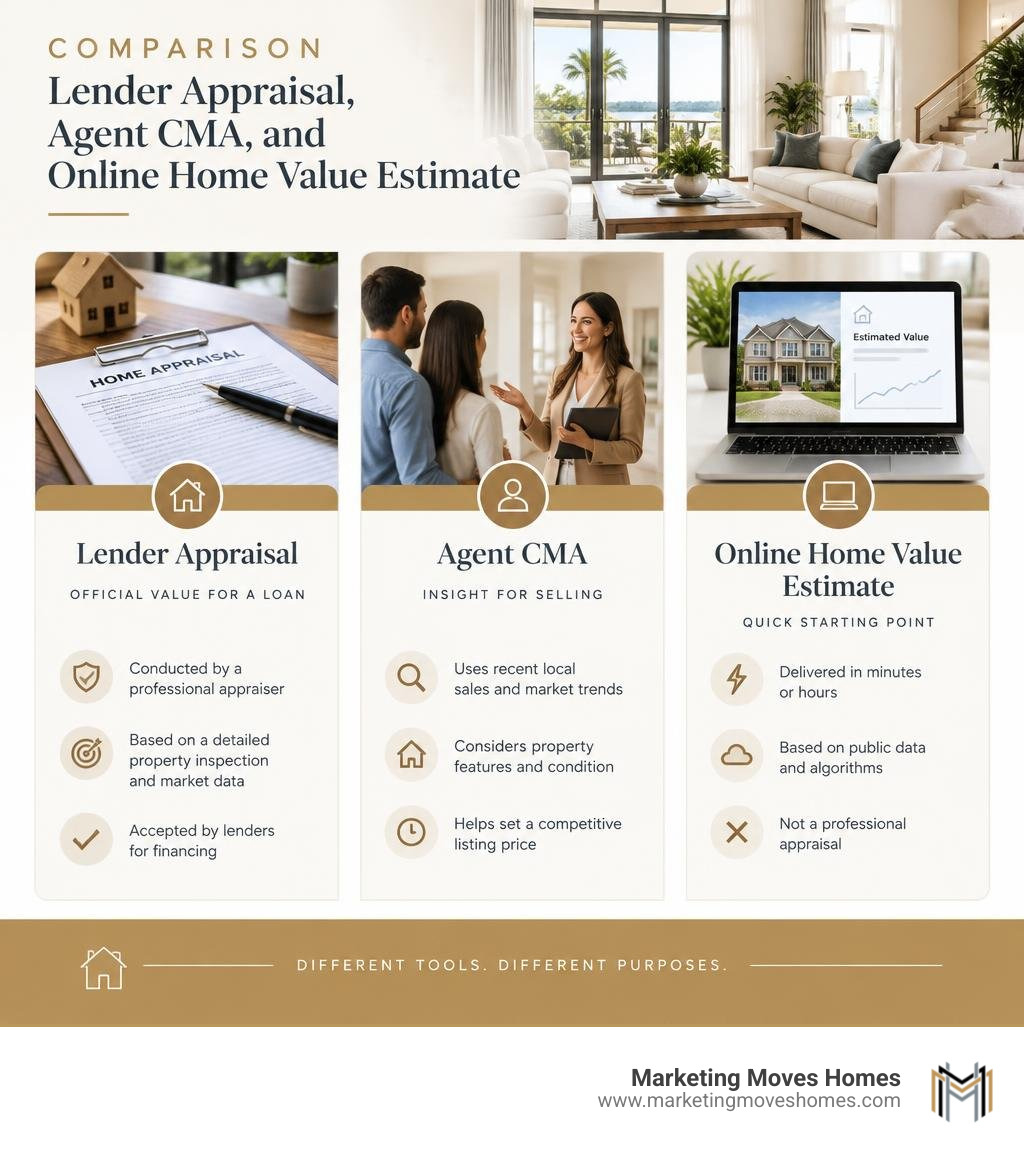
For a lender-accepted value, request a professional home appraisal through your lender. If you are planning to sell, start with a local agent’s comparative market analysis (CMA) of recent sales. An online estimate can give you a quick starting point, but it is not an appraisal.
Check which number you need before relying on it: a lender’s appraisal estimates market value for a loan, while your county’s assessed value is used to calculate property taxes. The two may differ, especially for a Lake Nona luxury home with features that online tools cannot fully assess.
I’m Scott Brazdo, MBA, a REALTOR® who helps Central Florida buyers and sellers understand the question, “What is the appraised value of my house?” My work with luxury homes and new construction helps me put that number in context with local sales and property features.
Important appraised value of my house terms:
Understanding Real Estate Valuations: Appraisals vs. CMAs vs. AVMs
When navigating the Central Florida real estate landscape, establishing an accurate figure for your residence requires understanding the three primary valuation mechanisms: a professional appraisal, a comparative market analysis (CMA), and an automated valuation model (AVM).
A professional home appraisal is an independent, legally binding assessment of fair market value conducted by a state-licensed or certified residential appraiser. Appraisers must adhere strictly to the Uniform Standards of Professional Appraisal Practice (USPAP). Mortgage lenders require these formal valuations during purchases or refinances to verify collateral before approving a loan. Under federal regulations, mortgage borrowers have the right to receive a full copy of their completed appraisal report at least three business days before closing.
By contrast, a Comparative Market Analysis (CMA) is an actionable pricing strategy prepared by a licensed real estate professional. We analyze active inventory, pending transactions, and recently closed comparable properties to determine an optimal listing or purchase price. Automated Valuation Models (AVMs), meanwhile, are algorithmic projections generated by computer models that crunch publicly available property data.
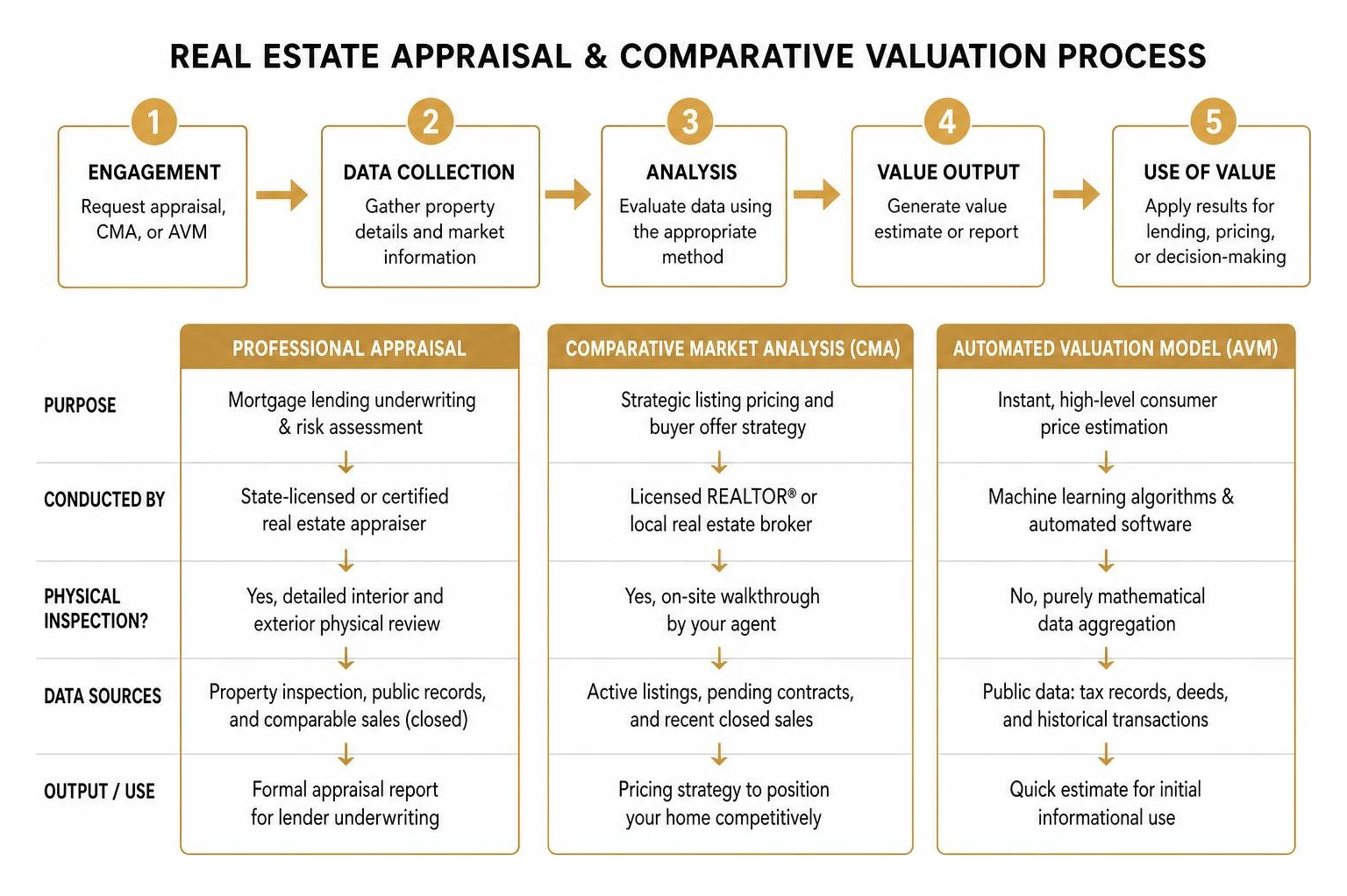
To help clarify the differences between these three valuation tools, we have outlined their key characteristics below:
| Feature | Professional Appraisal | Comparative Market Analysis (CMA) | Automated Valuation Model (AVM) |
|---|---|---|---|
| Primary Purpose | Mortgage lending underwriting & risk assessment | Strategic listing pricing and buyer offer strategy | Instant, high-level consumer price estimation |
| Conducted By | State-licensed or certified real estate appraiser | Licensed REALTOR® or local real estate broker | Machine learning algorithms & automated software |
| Physical Inspection? | Yes, detailed interior and exterior physical review | Yes, on-site walkthrough by your agent | No, purely mathematical data aggregation |
| Regulatory Standard | Governed strictly by USPAP standards | Guided by local real estate licensing & MLS rules | None |
| Lender Acceptance | Required for loan underwriting | Not accepted for primary mortgage financing | Rarely accepted for primary purchase mortgages |
Understanding these distinctions helps eliminate confusion when preparing for a sale or financing. For a deeper breakdown of how property estimations function, explore the ins and outs of home value estimates.
Why the Appraised Value of My House Differs from Automated Estimates
Homeowners often ask why algorithms miss the mark. Automated models rely on neural networks processing public tax rolls, deeds, and historical transaction data. Across the United States, popular platforms publish automated figures for over 120 million homes. However, algorithms possess an inherent blind spot: they cannot walk through your front door.
An automated tool cannot account for custom millwork, designer outdoor living spaces, upgraded quartz countertops, or panoramic golf course views in premier Lake Nona enclaves like Laureate Park or Lake Nona Golf & Country Club. Conversely, algorithms cannot spot structural deferred maintenance or outdated mechanical systems. When tax records contain errors regarding finished heated square footage or unpermitted additions, automated algorithms perpetuate those inaccuracies. If you are starting your valuation journey, review our beginner’s guide to getting a home value estimate to see how initial figures compare to formal valuations.
The Strategic Value of a Comparative Market Analysis (CMA)
While an appraisal looks historically at closed sales to protect a lender’s capital, a CMA crafted by Marketing Moves Homes looks at real-time market dynamics. In high-demand Central Florida luxury neighborhoods, market conditions evolve rapidly.
We evaluate active competing listings, absorption rates, and pending contract prices alongside closed historical data. Evaluating local supply shifts is essential, which is why tracking Orlando inventory levels directly informs whether pricing should be aggressive or balanced. This analysis guarantees your home is positioned strategically against current competition.
How to Accurately Determine the Appraised Value of My House
Determining a property’s true appraisal value involves a meticulous physical inspection paired with exhaustive neighborhood research. When an appraiser evaluates a luxury property, they perform a comprehensive on-site assessment, measuring exterior dimensions, verifying gross living area (GLA), inspecting roof and foundation integrity, and documenting the quality of interior finishes.

Appraisers grade properties according to standardized Quality (Q1 to Q6) and Condition (C1 to C6) ratings mandated by Fannie Mae and Freddie Mac. Every structural and cosmetic nuance influences this final calculation. For a comprehensive walkthrough of calculating exact property worth, refer to our step-by-step guide to estimate home value accurately.
Analyzing Recent Comparable Sales in Central Florida
The foundation of residential appraisal is the Sales Comparison Approach. Appraisers select three to six comparable properties (“comps”) that have closed within the previous three to six months, ideally within a one-mile radius of the subject home.
In master-planned communities across Lake Nona, Windermere, and Winter Park, appraisers apply line-item financial adjustments for key structural differences:
- Square Footage: Adjusting dollar-per-square-foot values for variations in gross living area.
- Lot Premiums: Accounting for waterfront locations, conservation backing, or oversized acreage.
- Architectural Upgrades: Pricing in summer kitchens, custom resort-style pools, multi-car garages, and smart-home infrastructure.
- Time Adjustments: Factoring in appreciation or market velocity when comps closed several months prior.
In luxury corridors, understanding how pricing affects transaction speed is vital. Reviewing the Lake Nona Realtor guide to days on market and fast sales provides valuable perspective on how proper initial valuation drives timely, high-value transactions.
Tracking Equity and Long-Term Property Appreciation
Knowing your home’s appraised valuation allows you to monitor equity accumulation and plan long-term wealth strategies. Whether you want to eliminate private mortgage insurance (PMI), evaluate cash-out refinancing, or prepare a high-end estate for a future sale, tracking valuation trajectory is essential.
When assessing property appreciation, strategic capital improvements—such as kitchen transformations or energy-efficient architectural additions—yield meaningful returns. To forecast your equity trajectory over future market cycles, consult our guides on how to estimate house value in 5 years and estimating your home value in 10 years.
Managing Valuation Challenges: Low Appraisals, Appeals, and Bias Reforms
Appraisal outcomes can vary with market conditions, and an appraisal that lands below the agreed contract price presents an operational hurdle. When a valuation shortfall occurs, the probability of a sale delay, cancellation, or price reduction can increase, making structured planning essential.

Ensuring your transaction stays on schedule requires structured planning. Familiarize yourself with navigating your Lake Nona real estate closing like a pro to protect your equity during negotiations.
What Should I Do If the Appraised Value of My House Comes in Low?
When an appraisal arrives lower than your purchase contract price or equity expectations, you have several structured paths forward:
- Audit the Appraisal Report for Material Errors: Examine the document line by line. Verify square footage calculations, bedroom/bathroom counts, and listed amenities. Simple clerical errors regarding architectural features can skew adjustments.
- Submit a Reconsideration of Value (ROV): Work with your real estate professional to compile three to four superior comparable closed sales that the appraiser omitted. Present these through the lender’s official ROV framework along with documented explanations.
- Exercise Appraisal Gap Clauses: In competitive purchase environments, buyers and sellers frequently negotiate appraisal contingency clauses specifying how much cash a buyer will bring to bridge a valuation shortfall.
- Renegotiate Contract Terms: The buyer and seller can agree to split the difference, lower the purchase price to the appraised figure, or adjust seller concessions.
- Request a Secondary Appraisal: If clear bias, severe methodology errors, or out-of-area comp selections exist, the lender may authorize a second independent appraisal.
Navigating these challenges requires steady advocacy. Learn how Lake Nona Realtors navigate the closing process for you to overcome appraisal discrepancies without sacrificing transaction momentum.
Addressing Appraisal Bias and Ongoing Industry Reforms
Valuation equity has become a central focus across the housing industry. A landmark study by the Brookings Institution analyzing data from the Federal Housing Finance Agency (FHFA) revealed systemic valuation disparities: homes in majority-Black neighborhoods were historically valued 21% to 23% lower than equivalent properties in non-Black neighborhoods, representing an estimated $162 billion in cumulative lost valuation across 113 major metropolitan areas. Furthermore, transactions in majority-Black neighborhoods were 1.9 times more likely to appraise below contract price.
In response, federal entities established the Interagency Task Force on Property Appraisal and Valuation Equity (PAVE). Oversight mechanisms utilizing the FHFA Uniform Appraisal Dataset (UAD)—containing over 46 million digital appraisal records—now monitor valuation practices for demographic bias, ensuring consistent, equitable valuation standards across all residential communities.
Property Appraiser vs. Tax Collector: Assessments and Property Taxes
Homeowners frequently confuse their county property appraiser with the county tax collector. These two government entities manage distinct parts of the municipal tax system:
- The County Property Appraiser: Determines the just (market) and assessed value of all real property within the county jurisdiction as of January 1 each tax year. The appraiser does not set tax rates, generate tax bills, or collect revenue.
- The County Tax Collector: Applies local taxing authority millage rates (set by county commissioners, school boards, and city councils) to the taxable value determined by the property appraiser, mails the official annual tax bills in November, and collects payments.
Each August, Florida property owners receive their Truth in Millage (TRIM) Notice. This document outlines your preliminary assessed value, proposed local millage rates, and estimated property tax liability before figures are finalized.
Florida Property Tax Exemptions and Assessment Caps
Florida provides strong statutory protections to shield primary homeowners from rapid property tax inflation:
- Homestead Exemption: Reduces a primary residence’s assessed value by up to $50,000 for qualifying permanent Florida residents, lowering school and general municipal taxable totals.
- Save Our Homes (SOH) Cap: Limits annual increases in the assessed value of homesteaded properties to 3% or the Consumer Price Index (CPI) rate, whichever is lower.
- Homestead Portability: Allows homeowners moving to a new Florida homestead to transfer up to $500,000 of their accumulated Save Our Homes tax savings to their new primary residence.
- Additional Exemptions: Specific reductions exist for qualifying seniors, disabled individuals, surviving spouses, and military veterans.
How to Appeal an Inaccurate County Assessment
If your county property appraiser assigns an assessed value that exceeds fair market value, you have formal appeal options:
- Informal Conference: Contact the county property appraiser’s office to discuss assessment calculations and provide evidence of errors or recent sales.
- Value Adjustment Board (VAB) Petition: If an informal review fails to resolve the issue, file a formal petition with the county Value Adjustment Board before the deadline (typically 25 days following the mailing of the August TRIM notice).
- Present Comparable Market Evidence: Attend your VAB hearing with documented closed sales, photographic condition reports, or an independent appraisal showing that market realities warrant an assessment reduction.
Frequently Asked Questions About Home Appraisals
How much does a professional home appraisal cost?
A standard single-family residential appraisal generally costs between $300 and $500. For complex luxury estates, waterfront properties, or custom homes across Lake Nona and Windermere, appraisal fees can range higher due to extensive research requirements, specialized architectural elements, and custom square footage calculations. The borrower typically covers this cost as part of loan closing fees.
How long is a residential appraisal report valid?
Most mortgage lenders consider a residential appraisal report valid for 120 to 180 days under standard underwriting guidelines. If a transaction timeline exceeds this window in a fluctuating market, the lender may require an appraisal update or recertification of value to confirm market stability.
Why do mortgage lenders require an appraisal before loan approval?
Mortgage lenders require an independent appraisal to protect capital reserves and mitigate default risk. The home serves as primary collateral for the underlying loan; verifying that the property’s fair market value supports the requested loan-to-value (LTV) ratio ensures the lender does not overextend financing beyond recoverable asset value.
Conclusion
Understanding your property’s true valuation brings clarity to every real estate decision, whether you are planning to sell an executive home, purchase new construction, or optimize home equity. While online estimation tools provide an accessible starting baseline, they cannot capture the custom upgrades, design details, and community atmosphere that define Central Florida’s premier neighborhoods.
At Marketing Moves Homes, we specialize in high-end residential listings across Lake Nona, Windermere, Doctor Phillips, and Winter Park. We combine strategic pricing analysis with marketing approaches—including professional architectural photography, cinematic video production, targeted digital outreach, and direct campaigns—to help our clients achieve exceptional results. If you are preparing to list your property or purchase your next residence, partner with our luxury real estate advisors for tailored guidance and local market insight.