
Estimated Home Value in 10 Years: How to Predict Your Property’s Future Worth
Estimated Home Value in 10 Years: How to Predict Your Property’s Future Worth
Estimate Your Home’s Value 10 Years From Now
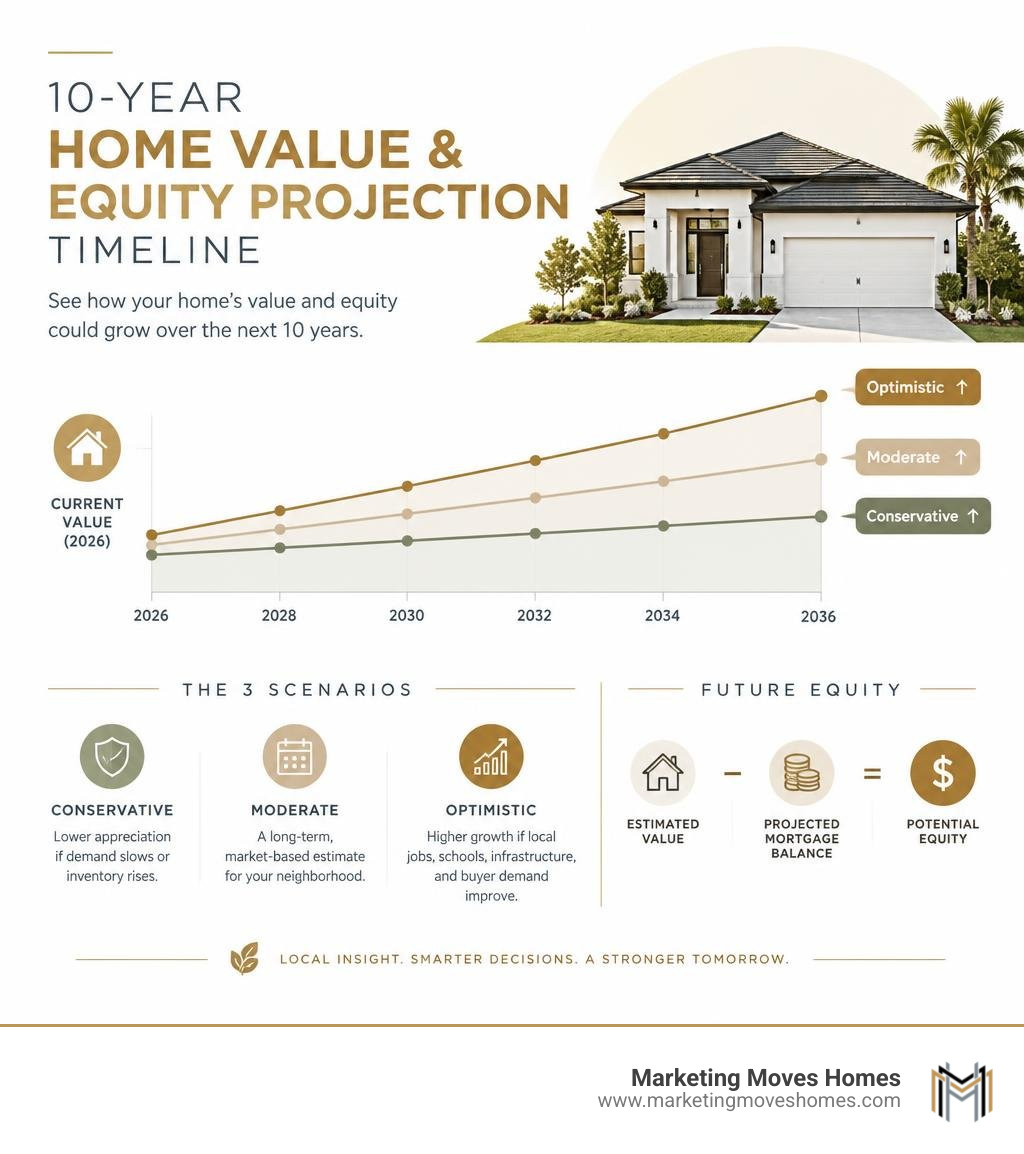
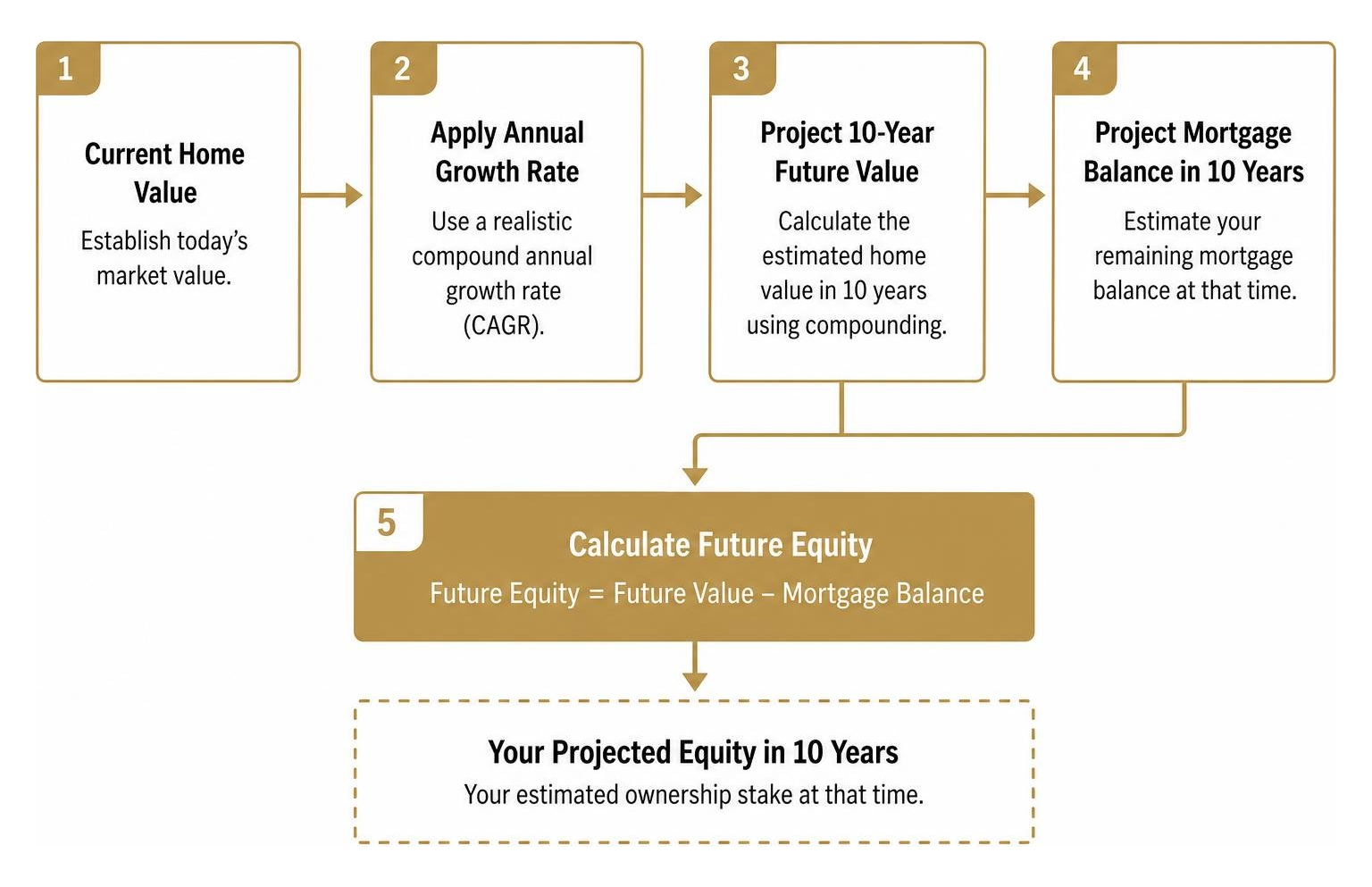
To estimate your home’s value in 10 years, start with a realistic current market value and apply an annual appreciation rate using this formula:
Future home value = Current home value x (1 + annual appreciation rate)^10
For a useful forecast, run at least three scenarios:
- Conservative: Lower appreciation if demand slows or inventory rises.
- Moderate: A long-term, market-based estimate for your neighborhood.
- Optimistic: Higher growth if local jobs, schools, infrastructure, and buyer demand improve.
Your future equity is different from future value. Subtract your projected mortgage balance from the estimated value to see how much ownership stake you may have. For Central Florida owners, especially in Lake Nona and the 32827 and 32832 ZIP codes, local comparable sales, new construction, insurance costs, and neighborhood growth can matter far more than a national average.
I’m Scott Brazdo MBA, a Central Florida REALTOR and co-founder of Marketing Moves Homes with more than 15 years of real estate-focused digital marketing experience and a background working with leading local builders, developers, buyers, and sellers. I use local market data, property positioning, and neighborhood-level insight to help clients make better decisions around an estimated home value in 10 years and their next move.
Estimated home value in 10 years vocab explained:
How to Calculate Your Estimated Home Value in 10 Years
Forecasting what a residential property will command on the open market a decade into the future requires a balance of mathematical discipline and localized context. Property values do not rise in a vacuum. Instead, they compound gradually over time while reacting to macro-economic cycles, local zoning evolutions, and the natural physical aging of the structure.
To calculate your projected appreciation accurately, you first need an airtight starting baseline. Many homeowners make the mistake of pulling a figure from generic algorithmic websites. While automated tools can provide a casual ballpark, they often miss recent interior improvements, lot premiums, and shifting micro-neighborhood dynamics across Central Florida. Learning the step-by-step methods to estimate home value accurately ensures your compounding calculations begin with authentic data.
The table below illustrates how different compound annual growth rates (CAGR) affect property values over a ten-year horizon across varied baseline price points:
| Baseline Property Value | Conservative Growth (2.0% Annual) | Moderate Growth (4.0% Annual) | High-Growth Market (6.0% Annual) |
|---|---|---|---|
| $400,000 | $487,598 | $592,098 | $716,339 |
| $550,000 | $670,447 | $814,134 | $984,966 |
| $700,000 | $853,296 | $1,036,171 | $1,253,593 |
| $850,000 | $1,036,145 | $1,258,208 | $1,522,220 |
| $1,000,000 | $1,218,994 | $1,480,244 | $1,790,848 |
The Compound Growth Formula for Your Estimated Home Value in 10 Years
Real estate appreciation works similarly to compound interest in a high-yield savings account or index fund: gains achieved in year one become the new base upon which year two builds. Over a full decade, this compounding effect turns modest percentage increases into substantial equity gains.
The mathematical formula is:
$$FV = PV \times (1 + r)^t$$
Where:
- FV = Future Value
- PV = Present Value (your current baseline market worth)
- r = Annual appreciation rate expressed as a decimal (e.g., 0.04 for 4%)
- t = Time horizon in years (10)
Historically, national residential real estate appreciation averages between 3.5% and 4.5% per year over multi-decade spans. However, high-demand southeastern hubs, master-planned developments, and innovative districts often outpace national averages during expansion phases. When planning long-range goals, it is also beneficial to incorporate mid-term forecasting strategies for 5-year house values to check whether your property is tracking ahead of or behind your baseline targets.
Factoring in Mortgage Principal Paydown vs. Price Appreciation

A common misconception among homeowners is equating total property appreciation with total personal equity. Appreciation reflects the gross market price of the physical asset. Your actual home equity, however, is calculated by subtracting your outstanding mortgage debt from that market valuation:
Total Home Equity = Projected Market Value – Remaining Mortgage Balance
Over a ten-year span, your equity expands through a two-sided mechanism:
- Asset appreciation: The market value of the home climbs upward.
- Amortization paydown: Your monthly principal payments gradually reduce the outstanding loan balance.
During the first five to seven years of a standard 30-year fixed-rate mortgage, the majority of every monthly payment goes toward interest. By years eight through ten, the amortization curve tilts, directing a greater percentage of each payment toward the principal balance. This accelerates equity accumulation, creating a widening spread between what you owe and what the property is worth.
Key Economic and Market Drivers Influencing Long-Term Property Worth
A ten-year horizon spans multiple micro-economic cycles. While you cannot predict every shift in the national economic landscape, understanding the underlying drivers of real estate valuation helps you anticipate how broader economic changes impact your asset. Grasping understanding the fundamentals behind home value estimates empowers you to look past short-term noise and evaluate long-term trends accurately.
Interest Rates, Inflation, and Regional Housing Demand
Mortgage interest rates act as a primary regulator of buyer purchasing power. When borrowing costs increase, monthly payments rise for financed purchases, compressing buyer budgets and moderating price growth. Conversely, when rates stabilize or decrease, buyer borrowing capacity expands, stimulating demand and supporting steady appreciation.
Inflation also plays a dual role in real estate valuation:
- Replacement Costs: General inflation increases the cost of building materials, labor, and land development, making new home construction more expensive and supporting existing home values.
- Real vs. Nominal Appreciation: If a property appreciates at 4% annually while inflation runs at 3%, the “real” purchasing-power gain is approximately 1% per year.
In high-growth enclaves such as Lake Nona, strong local employment, specialized medical clusters, and premium amenities often create sustained buyer demand that helps buffer against broader national slowdowns. Homeowners tracking these trends can review local interest rate trends and home price movements in Lake Nona to see how capital costs interact with neighborhood-level demand.
Housing Inventory, Zoning Laws, and Community Development

Supply and demand fundamentals ultimately drive property values. In mature, highly sought-after communities like Winter Park, Windermere, and Doctor Phillips, strict municipal zoning laws and geographic constraints limit new construction, creating a natural supply cap that supports long-term property values.
In expanding master-planned areas like Lake Nona (including ZIP codes 32827 and 32832), long-term appreciation is closely tied to infrastructure development. The expansion of research centers, corporate hubs, commercial districts, and top-rated public schools creates ongoing demand for housing. Keeping an eye on housing inventory trends across the Orlando market helps owners understand whether local market conditions favor sellers or buyers over multi-year holding periods.
Property-Specific Factors That Impact Decade-Long Equity
Macroeconomic trends establish the baseline for regional real estate growth, but individual property characteristics determine where your home lands within that range. Two identical houses built in the same neighborhood ten years ago can show significantly different market values today based on maintenance history, capital improvements, and structural care.
Balancing Renovations and Maintenance for Your Estimated Home Value in 10 Years
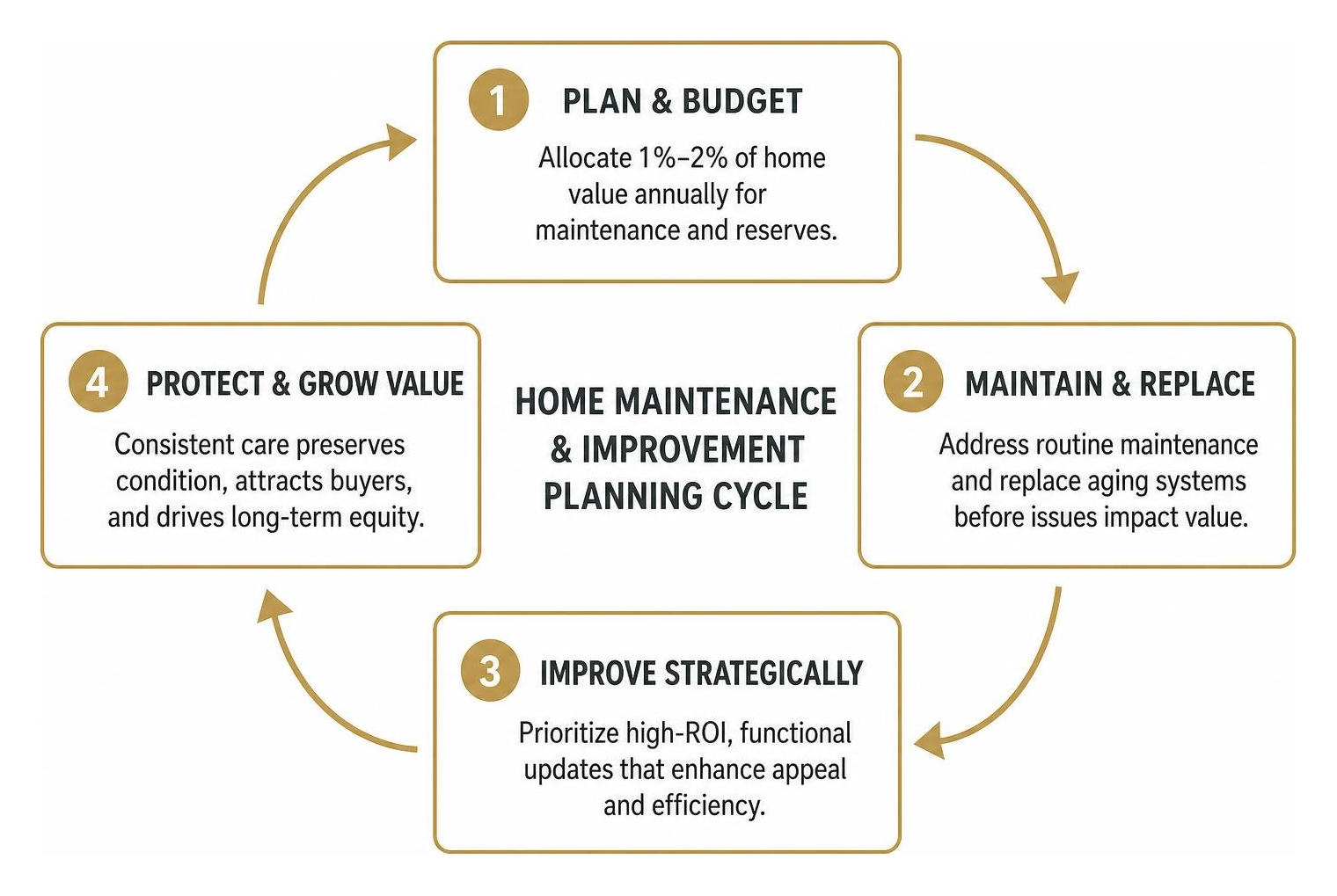
Every residential structure experiences physical depreciation over time. Roofs age, HVAC systems lose efficiency, water heaters reach the end of their operational lifespan, and interior design trends evolve. Without proactive maintenance, structural and cosmetic depreciation can erode annual market appreciation.
Homeowners who achieve top-tier appreciation typically follow two strategic guidelines:
- Allocate an Annual Maintenance Reserve: Setting aside 1% to 2% of the home’s value annually ensures routine maintenance and system replacements occur before deferred upkeep harms market appeal.
- Prioritize High-ROI Improvements: Over a ten-year horizon, practical functional updates typically deliver higher returns than overly personalized luxury additions. High-efficiency HVAC replacements, roof updates, modernized kitchen surfaces, and refreshed outdoor spaces consistently preserve and enhance resale value.
Environmental Risks, Climate Resilience, and Carrying Costs
Long-term equity calculations must account for the ongoing carrying costs of homeownership. In Central Florida, insurance premiums and municipal property taxes play an active role in a buyer’s total monthly payment capacity.
- Flood Zones & Elevation: Properties in designated flood zones or low-lying areas often face higher flood insurance requirements, which can soften buyer demand compared to homes on higher ground.
- Roof Age & Wind Mitigation: Wind-mitigation features—such as secondary water barriers, hurricane clips, and modern architectural shingles—help lower homeowner insurance costs and make properties more attractive to buyers.
- Energy-Efficient Features: Upgrades like variable-speed pool pumps, multi-zone heat pumps, and low-E double-pane windows reduce monthly utility expenses, adding tangible appeal during resale negotiations.
Financial Planning Goals: Selling, Refinancing, or Legacy Wealth
Understanding your projected equity over a 10-year timeline allows you to align your property with broader wealth-building strategies:
- Selling and Relocating: If your ten-year goal involves downsizing, upgrading, or relocating, calculate your net proceeds rather than relying solely on gross appreciation. Learning how to calculate net proceeds from a future home sale helps you account for loan payoffs, title expenses, and transactional costs.
- Accurate Cost Planning: A reliable seller net sheet outlines municipal transfer taxes, closing fees, and brokerage representation investments. Utilizing a seller net sheet to estimate real estate closing costs provides a clear view of your net equity before listing.
- Refinancing & Equity Utilization: A decade of steady appreciation and principal paydown often opens opportunities for rate-and-term refinancing, home equity lines of credit (HELOCs), or funding major life milestones.
- Long-Term Estate Planning: Real estate remains a cornerstone for intergenerational wealth transfer, offering favorable tax treatment and steady capital preservation.
Frequently Asked Questions About Decade-Long Home Values
What is a realistic annual appreciation rate to use for a 10-year projection?
A realistic baseline for long-term residential forecasting is between 3.0% and 4.5% annually. While rapid expansion periods can produce short-term double-digit gains, using a conservative 3.0% to 4.0% rate helps protect your long-range financial planning from broader market fluctuations.
How do online automated valuation models compare to professional appraisals?
Automated online estimates rely on public records, automated algorithms, and broad statistical averages. They cannot evaluate interior condition, recent luxury renovations, floor plan flow, lot orientation, or real-time hyper-local buyer interest. A professional comparative market analysis (CMA) or an on-site appraisal provides a far more accurate valuation by accounting for property condition and neighborhood-specific factors.
How does my remaining mortgage balance affect my future home equity?
Your mortgage balance directly determines your realized equity. Over a 10-year period, regular amortized payments lower your outstanding principal while the market value of the property rises. Your true equity equals the future market value minus your remaining loan payoff at that time.
Conclusion
Forecasting your property’s value a decade from now offers a practical framework for building long-term equity, timing future transactions, and managing your real estate assets wisely. By combining conservative compound appreciation rates, consistent property maintenance, and regular amortization tracking, you can plan your financial future with confidence.
Automated valuation algorithms and broad national averages can provide a starting point, but they miss the neighborhood dynamics that drive long-term value in Central Florida. If you want a tailored valuation of your property’s current worth and projected growth, connect with Scott Brazdo and the team at Marketing Moves Homes. As your trusted local brokerage partner, we use professional photography, targeted digital marketing, and local market insight to help you achieve your goals. Whether you are preparing to list your property or looking to explore Central Florida real estate services and home buying opportunities, we are here to guide you every step of the way.